Showing posts with label roxas boulevard. Show all posts

Saturday, March 15, 2014

A.M. Shorts: E.A. Perkins Residence


 'El Nido', the Eugene Arthur Perkins residence along Dewey Boulevard in Ermita. Ⓒ Manila Nostalgia/Lou Gopal

In pre-war Manila, houses of illustrious families were designed by well-known architects according to their elegant tastes. Their homes were either designed in the renaissance, art-deco, beaux-arts, or the traditional Filipino bahay na bato style. But one house stood out among the rest, and this was the El Nido, the residence of Eugene Arthur 'E.A.' Perkins, and his wife Idonah Slade. The house and the family became the center of intrigue among Manila's high society because of domestic quarrels between Eugene and Idonah.

The owner of the house, E.A. Perkins, was the first American envoy to the Royal Court of Siam (Thailand's counterpart of the Royal Court of St. James). Born in Bangkok in 1888, he went to Manila and became a partner of the law firm DeWitt, Perkins, and Brady. In 1935, Sen. Juan Ponce Enrile's father Alfonso Ponce Enrile joined the firm and was renamed DeWitt, Perkins, Brady, and Ponce Enrile. Their law firm was located in Edificio Soriano (formerly as the Geronimo de los Reyes Building) in Plaza Cervantes. 

E.A. Perkins (right), checking the shipment of Lepanto gold with Hong Kong and Shanghai Bank manager W. Webster (right) in 1949. Ⓒ Lougopal.com/Manila Nostalgia

The Perkins residence was designed by the great Andrés Luna de San Pedro in the Moorish Mediterranean style. The house, which faces the Manila Bay, was located in the residential section of Ermita, where homes of prominent Filipino and expatriate families once stood. As their home stood out among the rest, it won the title of The 'Most Beautiful Home of 1928', a year before the Zóbels won theirs a year later.

Dewey Boulevard and its environs in the 1920s. the El Nido was located at the corner of Dewey Boulevard and Calle Divisoria (now Salas St.). Ⓒ Lougopal.com/Manila Nostalgia

  The penthouse living room of the Perkins residence in Ermita. Ⓒ Manila Nostalgia/Isidra Reyes

One of the rooms inside the El Nido. Ⓒ Manila Nostalgia/Isidra Reyes 

When the Philippines became a commonwealth in 1935, the American governor-general had moved out of Malacañang Palace and was replaced by a High Commissioner (an equivalent of an ambassador). The High Commissioner was in need of his own residence. So, in 1937 when the newly-appointed High Commissioner Paul V. McNutt arrived in Manila, Attorney E.A. Perkins offered his El Nido to be McNutt's home until a permanent residence for the High Commissioner is finished. 

President Manuel L. Quezón (left) enjoying cigarettes with American High Commissioner Paul V. McNutt (right). Ⓒ Jweekly.com

In the 1950s, shortly before E.A. Perkins died, he sold his property. The new owner had the El Nido demolished and was replaced by an apartment known as the L&S Building, which was designed by Alfredo Luz. 


Sunday, March 9, 2014

A.M. Shorts: Alfonso Zóbel and Carmen Pfitz Residence


The Alfonso Zóbel and Carmen Pfitz de Zóbel residence along Dewey Boulevard (now Roxas Boulevard) cor. Calle Padre Faura in Ermita. Ⓒ Manila Nostalgia/Isidra Reyes

The pre-war years was considered the golden age of Philippine social scene, before its rebirth in the 1950s to the 1960s, that is because most of Manila's alta sociedad actively participated in social activities such as dance, polo matches, parties, and more. The pre-war alta sociedad composed mostly of Filipino families that are of European descent, families such as the Zóbel de Ayalas, Roxases, Elizaldes, Nietos topped the social scene with their elegant tastes in clothing and houses.


The Alfonso Zóbel house featured in André de la Varre's travelogue entitled Manila: Queen of the Pacific Ⓒ Manila Nostalgia/Paulo Rubio

Alfonso Zóbel de Ayala Roxas is the son of famous pre-war industrialist and philanthropist Don Enrique Zóbel y de Ayala, and father of former Ayala Corporation chairman Jaime Zóbel de Ayala. Carmen Pfitz Herrero, on the other hand, is a member of the Pfitz clan of Spain and the Philippines. Her brother, Enrique Pfitz Herrero, became a member of the Ortigas family, marrying Doña María Luisa Ortigas de Ynchausti de Pfitz. Together with his wife, Carmen, the couple had built a grand mansion for their family. 

Note: Names are written in standard Spanish naming custom. Spanish names are written without the Filipino 'y'. So, for males (or single females), it would be [given name][paternal family name][maternal family name]. For married females, it would be [given name][paternal family name][maternal family name]de[husband's family name]. For widows, it would be [given name][paternal family name][maternal family name]vda.de[husband's family name].

 Don Alfonso Zóbel de Ayala (left), with his son Jaime Zóbel de Ayala. Photo probably taken sometime in the 1950s. Ⓒ Manila Nostalgia/Paulo Rubio             

The Zóbel de Ayala family portrait. From L-R standing: Da. Matilde Zóbel de Ayala de Albarracín Segura, D. Jacobo Zóbel de Ayala Roxas, D. Alfonso Zóbel de Ayala Roxas, Da. Carmen Pfitz Herrero de Zóbel de Ayala. L-R seated: Da. Angela Olgado Calvo de Zóbel de Ayala, Da. Fermina Montojo Torróntegui de Zóbel de Ayala, Da. Consuelo Zóbel de Ayala Montojo de Alger, Da. Gloria Zóbel de Ayala Montojo de Padilla, D. Enrique Zóbel de Ayala Olgado, Da. Maria Victoria Zóbel de Ayala Pfitz de Vallejo-Nájera, D. Enrique Zóbel y de Ayala (patriarch), D. Fernando Zóbel de Ayala Montojo, D. Joseph R. McMicking, Da. Mercedes Zóbel de Ayala Roxas de McMicking. Ⓒ Manila Nostalgia/Paquito dela Cruz

The house, located along the scenic Dewey Boulevard corner Calle P. Faura in residential Ermita, was designed by the great Andrés Luna de San Pedro, son of the great painter-nationalist Juan Luna. The house had been designed in the French Renaissance style, which was the prevalent design of the houses of Manila's elite. The house had survived the devastating Battle of Manila in 1945, and after the war, Don Alfonso sold the house to compensate what they had lost during the war years. Their house became the offices of the French Embassy in Manila when the Zóbels moved to their new home in suburban Makati. The French Embassy soon vacated the house and moved to another location. Subsequently, the house became the branch of the Bank of Asia for a period of time.

 After the Bank of Asia vacated the mansion, art galleries were transferred to the mansion due to the renovation of the adjacent Tesoro's. Ⓒ Manila Nostalgia/Isidra Reyes
                            
The Bank of Asia had vacated the mansion and art galleries from nearby Tesoro's occupied the property due to the renovation of the latter. Sadly, this mansion was not spared from the destruction of the wrecking ball. We at AM assume that the Zóbels had disposed of the property before it was demolished. The 1322 Golden Empire Tower now stands on this property. 

The Alfonso Zóbel mansion along Roxas Boulevard, probably taken sometime in the 1990s. Ⓒ Manila Nostalgia/Paulo Rubio

Thursday, August 15, 2013

Ramón Magsaysay Center


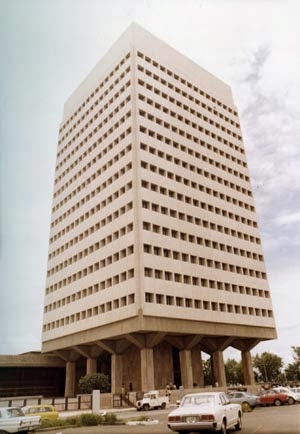
The Ramon Magsaysay Center during the 80s. © Ramon Magsaysay Award Foundation

The Ramón Magsaysay Center is an eighteen-storey edifice built in honor of Philippine President Ramón Magsaysay, who died in a plane crash in Cebu in 1957. The brutalist edifice is located at Roxas Boulevard facing the famous Manila Bay and its sunset. The center currently houses the Asian Library and the offices of the Ramón Magsaysay Award Foundation, the governing body of the Ramón Magsaysay Award, Asia's Nobel Prize.

The RM Center during the 1970s. Viewed from Roxas Boulevard. Note that the Silahis International Hotel/Grand Boulevard Hotel is in its construction progress. © Flickr/rubiopr27

Built in 1967 at the corner of Roxas Boulevard and Dr. Joaquin Y. Quintos St., the Ramon Magsaysay Center was designed by Arturo J. Luz & Associates, in consultation with Italian-American Pietro Belluschi and Alfred Yee Associates, both from the United States and pioneers in designing pre-cast and pre-stressed concrete building structures.   

The Ramon Magsaysay Center was the first structure in the country to sport column-free structural concept. The design used pre-cast and pre-stressed beams like a tree rooted on the ground. © Arkitekturang Filipino

That early, the building designers decided to adopt the use of a novel structural system -- the pre-cast, pre-stressed concrete beams and multiple in-place floor slabs and wall panels. The main column of the building is the cast-in-place concrete shear wall core (Moment Frame) over deep concrete piles. This structural system is resistant to lateral forces due to earthquakes or wind load. In effect, the building is designed like a big tree with the columns as its deep-rooted trunk that sways with the wind and the movement of the ground. For elegance and engineering integrity, secondary pillars were installed all covered with travertine cladding.


Ramón Magsaysay Center viewed from below. © That Happy Day  


The center's pre-cast and pre-stressed concrete beams which acts like a trunk rooted on the ground. © Urban Roamer

The Center's spacious reception hall. © Karl and Dianne Sarte

A statue of President Magsaysay placed on the lobby of the building. © Maspaborito.com

The credo of President Magsaysay. © Urban Roamer

The exterior of the Ramón Magsaysay Center was designed to withstand the salty environment that surrounds the building. It was clad with travertine marble slabs embedded in the frame of the building. These types of materials require minimal maintenance but still gives an elegant view of the building.