Showing posts with label manila. Show all posts

Sunday, March 8, 2015

Heacock's Department Store


A typical scene outside Heacock's Department Store along the Escolta. © Manila Nostalgia/John Harper

Long before the existence of today's department stores such as Rustan's, Robinson's, and the ever-famous Shoemart, now known as SM, there were already department stores that were far more luxurious than that of today's. Manila, being the city that boasted numerous feats in architecture, also hosted and boasted the finest shops and stores in all of the Orient. One of these department stores was Heacock's, probably the most recognized and popular stores in the city back in the day.

Heacock's Department Store first became a jewelry store operating under the partnership name Heacock & Freer, two American brothers-in-law from San Francisco. H.E. Heacock, one of the partners, was a travelling salesman originally hailed from Salem, Ohio and first came to the Philippines in 1901 to open a branch of his jewelry store. After arriving in Manila, Heacock & Co. set up shop on the second floor of the McCullough Building at the foot of the Santa Cruz Bridge. Since then, Heacock & Co. became the best known American jewelry store in the city.

H.E. Heacock, one of the founders of H.E. Heacock & Company. © Filipinas Heritage Library

In 1909, the brothers-in-law Heacock and Freer sold the company to Samuel Francis Gaches, a young American entrepreneur-turned-philanthropist who arrived in Manila in the same year as Heacock, but the reason being is that Gaches worked for the American colonial civil service.

Samuel Francis Gaches, president of the H.E. Heacock & Company. © Filipinas Heritage Library

In the post-Gaches acquisition of the company, the year 1910, H.E. Heacock & Co. transferred its operations south, at an old building along the five-block Escolta. The old Escolta shop was renovated and had the most modern storefront in all of Manila with its products displayed in front, a first in the country. Eight years later, in 1918, Heacock's transferred its operations again due to the success of the department store. It moved one block east, along the Escolta corner Calle David. The new four-storey Heacock's Department Store was the most modern of its time. The department store was built on the lot of American businessman William J. Burke, the owner of the Burke Building on the Escolta.

The pre-1918 Heacock's Department Store along the Escolta. © Manila Nostalgia/Isidra Reyes

As the years progress, Heacock's grew larger in terms of popularity and in assets. The H.E. Heacock & Company opened branches in other parts of the Philippines such as in Baguio, Cebu, Davao, and Iloilo. Heacock's, being the country's largest department store back in the day, carried imported luxury goods from the Elgin Watch Company, which carried the brands Lord Elgin, Lady Elgin, and Elgin. Other brands include Remington Typewriters, Rogers Flatware, International Silver, and Frigidaire Refrigerators.

An ad from the Philippines Free Press dated December 1923 from Heacock's Department Store. © Manila Nostalgia/Aksyon Radio La Unión

The year 1929 saw the birth of a stronger and larger Heacock's Department Store. Gaches and the H.E. Heacock & Company started the construction of the one million peso (P1,000,000.00), eight-storey Federal style building on the corner of Calle Escolta and Calle David. The new Heacock Building was designed and constructed by the triumvirate of the Filipino architect Tomás Argüelles, the American W. James Odom, and the Spanish Insular Fernando de la Cantera. Opened a year later, the Heacock Building had the same features that of the old Insular Life Building at Plaza Moraga.

Construction of the new Heacock Building in 1929. © Lougopal.com/Manila Nostalgia 

In an article of the American Chamber of Commerce Journal in 1930, the new million-peso Heacock Building was described as being one of the tallest in the city. The article also described the interior layout of the department store.

"The main entrance on the Escolta opens into Heacock’s proper, the jewelry store; then comes Denniston’s, the photographic department, with its valuable Eastman agency, and then the office equipment department. The jewelry store is L-shaped; one of the illustrations gives a good view of it.

In the new building the Heacock store occupies the main and mezzanine floors, both handsomely finished and artistically arranged. The second floor is also all occupied by the Heacock company; the offices are there, and the stock, accounting, mail order, wholesale and optical departments. Four rooms on the third floor are given over to stock and records; the other rooms of that floor are rented as offices, as are the rooms and suites of the fourth, fifth and sixth floors. These rooms, all of them desirable because of their location and the building they are in, offer great latitude of choice.

The seventh floor accommodates Heacock’s engraving and printing, watch-making, metal engraving, jewelry repairing and manufacturing departments; also the optical shop, Denniston’s photo laboratories, and stock of the office equipment department.

The basement, under the entire building, counts as the eighth floor. It is to accommodate automobiles during the day. Seventy-five cars will not crowd it; a wide ramp opens from Calle David, egress and ingress are safe and convenient. This public service in connection with the Heacock building will materially mitigate the downtown parking nuisance." (excerpt from the American Chamber of Commerce Journal)

The new million-peso, eight-storey Heacock Building. © Manila Nostalgia/Isidra Reyes (Retrieved from Arquitectura Manila Photo File)

Interior of the Heacock Building on its opening in 1930. © Lougopal.com/Manila Nostalgia

The triumvirate-designed edifice only lasted for seven years. In 1937, a powerful earthquake hit the Philippine capital which heavily damaged the Heacock Building. The building suffered irreparable damages which led to the demolition of the eight-storey building. Heacock's shut down its business and was quickly reorganized a month after the earthquake. 

The new edifice, also eight stories high, replaced the old demolished Heacock Building. The new building, built in the streamline art deco style, was designed also by Tomás Argüelles, but with Fernando H. Ocampo and the American George E. Koster.

The new H.E. Heacock & Company Building in 1940. © Manila Nostalgia/Dominic Galicia

The streamline art deco building had the latest in building technology, it had installed pneumatic tubes which could transport small parcels throughout the building without the need of a messenger. The building cost around P800,000.00, which is P200,000.00 cheaper than the triumvirate-designed Federal style building. 

The new H.E. Heacock Building (center) houses Heacock's Department Store and the ammunition storage of the Philippine Army. © LIFE via Lougopal.com/Manila Nostalgia

The deadly Battle of Manila in 1945 greatly reduced the city into rubble. Escolta, home of the city's financial district, was obliterated by bombshells and gunfires. The Heacock Building was damaged but was reconstructed after the war. 

The war-torn H.E. Heacock Building, 1945. © Skyscrapercity.com


Saturday, December 20, 2014

A.M. Shorts: Michel Apartments


The Michel Apartments at its splendor. Ⓒ Manila Nostalgia/Isidra Reyes

Long before the rise of multi-storey residential apartments in post-war Manila such as in Makati, there were already numerous apartments that were as elegant, if not, more elegant, than those of today's, in pre-war Manila. Manila, being the capital of a prosperous Philippine Islands, was once home to many expatriates of different nationalities, such as Spanish, American, British, and German. And within the confines of the modern residential section of Ermita and Malate lies the Michel Apartments, one of the city's top residential apartment.

The Michel Apartments was an art-deco, mid-rise apartment building designed by Francis 'Cheri' Mandelbaum, whose other work was the Rosaria Apartments nearby. Mandelbaum was an American architect trained in Cornell University in Ithaca, New York. He also spent some time in the Philippines, coming to the islands in 1904 to work in the Bureau of Public Works with William Parsons, urban planner and architect of the Paco Station of the Philippine National Railways. Also, he worked as a professor of architecture at the University of Santo Tomás in Manila. 

At some time, the Michel Apartments was the tallest apartment building in the City of Manila. 


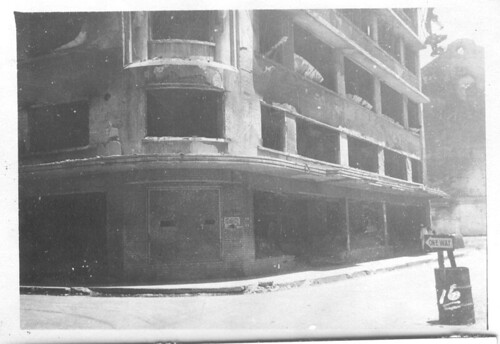
The Michel Apartments lay in ruins after the liberation of the city in 1945. © Manila Nostalgia/Isidra Reyes

The Michel Apartments stand nine storeys high on a 1730-square meter lot along Calle A. Mabini in Malate, the residential section of the city where many of the country's pillars in social, economic, and political institutions resided. The Michel was commissioned by Don Pedro Sy-Quia y Encarnacion, a scion of the old and landed Sy-Quia family from the north. The Michel was said to be named after his wife, Doña Asuncion Michels de Champourcin y Ventura, a mestizo from Pampanga.

This year, 2014, the Michel Apartments was hounded with a demolition permit, despite of it being a protected structure under law. The demolition of the Michel Apartments was stopped by heritage conservation activists and citizens alike through the "cease-and-desist order" from the court. But, the demolition of the Michel had already started when the court ruling came out, so it would be of no use.

Destruction of heritage structures should be given the highest priority, as physical heritage is rapidly declining because of irresponsible governance of local leaders. If the government continues to act in a way like they do not give importance to the country's heritage, then these structures will be prey to money-hungry developers.


Friday, December 19, 2014

A.M. Shorts: Admiral Apartments

The Admiral Apartments back in the day, photo probably taken after the war. Ⓒ Manila Nostalgia/John Harper

The grandeur of pre-war Manila makes people of today reminisce about the past, the past that has been prosperous and plentiful. Manila, being the finest city in the Orient proves its stately grandeur through the representation of the city's finest homes, shops, and imposing structures. Sadly, many of the structures that Manila boasts and had boasted is now being turned into fine pieces of powder as they are being demolished to pave way for the so-called "progress".

Along the scenic Dewey Boulevard, where the pride of the City of Manila, the Manila Bay, is located, there were numerous stately homes and apartments that stood in front of its glowing waters. One of them is the Admiral, located at the corner of Dewey Boulevard and Cortabitarte. The Admiral Apartments had been home to numerous historical figures, both local and global, and had been a witness to the gruesome days of the Second World War.


Admiral Apartments during the post-war years. © Manila Nostalgia/Isidra Reyes

The Admiral Apartments along Dewey Boulevard, now Róxas Boulevard, was a work of the eminent Fernando H. Ocampo, whose other works include the Calvo Building along Escolta, Angela Apartments in Malate, and the post-war rehabilitation of the Manila Cathedral. Built in 1938 and completed in 1939, the Admiral Apartments was commissioned by Don Salvador Araneta Zaragoza and his spouse, Doña Victoria López de Araneta.


Salvador Araneta Zaragoza and Doña Victoria López de Araneta. 


The Admiral Apartments, after its opening in the late 1930s, was one of the tallest residential building in the city, with eight storeys high living quarters. Because of its height, the Admiral became the focal point of sailors and ships anchoring in Manila Bay. 

Modern-day Admiral Apartments-turned hotel. Ⓒ Manila Nostalgia/Isidra Reyes

According to Manila society legends, the Admiral was conceived by Doña Victoria's mother, Doña Ana López Ledesma. It was said that Doña Ana was responsible for financing the construction of the Admiral to please and impress the Aranetas, specifically Don Salvador's father Don Gregorio Araneta Soriano, because it has been told that Don Salvador had married Doña Victoria without their knowledge.

The Admiral was designed in the art-deco style, designed by the eminent Fernando H. Ocampo. According to an architectural historian, he described the Admiral of having "an air of quiet elegance with definite Spanish touches in the design of its façade. The apartments were pleasant spacious, airy, and bright rooms. The Spanish feeling became more pronounced in the reception room that opened directly to a side street. Both the furniture and the metal chandeliers reflected a Spanish Gothic style, rather forbidding in its formality." (excerpts from a PowerPoint presentation by Isidra Reyes. Retrieved from Manila Nostalgia)

The features of the Admiral's interiors, such as the main dining halls, were designed with different themes and motifs. "The main dining room, called the Malayan Court, was so-called due to the strong Malayan motif of its design and an imposing mural painting by Antonio Dumlao. The Spanish Room was a reception room while a small dining room called the Blue Room was done in royal blue, old rose, crystal, and silver. A cocktail lounge called the Coconut Grove was decorated with a coconut trees with green light bulbs as fruits, inspired by the Cocoanut Grove Nightclub at the Ambassador Hotel in Los Angeles." (excerpts from a PowerPoint presentation by Isidra Reyes. Retrieved from Manila Nostalgia)

During the war, the couple's own home, the Victoneta I, was seized by the Japanese and made it their headquarters. So, the couple and their family moved to the Admiral to seek refuge, along with other members of the López-Araneta families. It has been said that Doña Victoria personally did the washing of the dirty linens and taking phone calls as the Admiral Apartments was understaffed. In the last days of the war, the Japanese took control of the Admiral Apartments. With that, the Araneta couple moved out of the Admiral and sought refuge in Baguio along with other members of the López-Araneta family. 


The Admiral Apartments (top center), during the liberation of Manila in 1945.Ⓒ Manila Nostalgia/Andi Desideri 

The battle for the liberation of the City of Manila left most of the city in ruins. The Admiral Apartments was not severely damaged in the fight for the recapture of the Philippine capital. Shortly before the capitulation of the Japanese forces in the Philippines, top commanders of Allied nations in the Pacific stayed in the Admiral Apartments. The Supreme Commander of the Allied Forces in the Pacific and Field Marshal of the Philippine Army Douglas MacArthur has made the Admiral his temporary home after his home in nearby Manila Hotel was bombed out during the liberation. The British supreme commander, The Earl Mountbatten of Burma, formerly Prince Louis of Battenberg, uncle of Prince Philip, Duke of Edinburgh, also stayed in the Admiral Apartments.

Construction workers demolish the Admiral Apartments. Ⓒ GMA News/Danny Pata

This year, in 2014, news regarding the Admiral Apartments sparked when it was reported that it is being demolished to pave way for a new development, the Admiral Hotel by Anchor Land Holdings. Petitions have been made throughout social media by heritage conservation activists and ordinary citizens alike, saying that the capital city of Manila has already had too much "massacre" of heritage buildings. The petition for the stopping of the demolition had reached the Manila City Hall, but took a blind eye on the issue. So, the developer, Anchor Land Holdings, continued the demolition, much to the disappointment and frustrations of heritage conservationists.

The year 2014 has already been a roller-coaster ride for Philippine heritage. No concrete plans and actions have been laid out by the government for the protection of heritage structures. As long as there are no concrete and stricter laws regarding the destruction of heritage structures, they will fall prey to greedy developers whose aim is to destroy the country's physical heritage. 

Thursday, November 6, 2014

De La Salle University St. La Salle Hall


The St. La Salle Hall of the De La Salle University during its heyday. © Manila Nostalgia/Gilbert Jose

Many have either walked past by this building or have walked through its halls. This outstanding structure is the epitome of institutional architecture in the Philippines, mainly because of its classical ornaments such as its white-washed walls and spacious halls. The St. La Salle Hall embodies the spirit of not just of the green and white, but also embodies the triumph of Catholic education in the Philippines.

Lasallian education in the Philippines was established in 1910 when the pioneer brothers arrived. It was not until in 1911 when the Brothers opened a school, which was then called the De La Salle College, at the Pérez Samanillo compound in Calle Nozaleda in Paco. Ten years later, as the student population began to increase and due to the lack of space, the De La Salle College moved to a much wider lot in the southwestern part of the city, along Taft Avenue in Malate.


Construction of the St. La Salle Hall of then-De La Salle College. © Manila Nostalgia/Gaby Tinio


A competition for the design of the new school building was initiated by the Lasallian brothers. Tomás Mapúa, a pensionado architect, won the competition against nine other entries and was awarded with a prize of P5,000.00. Mapúa is the country's first registered architect who was one of the first-generation pensionado architects who studied abroad. Educated in Cornell University in New York, he became one of the country's leading architects during the pre-war years, with projects such as the De La Salle University's St. La Salle Hall and the Philippine General Hospital. 

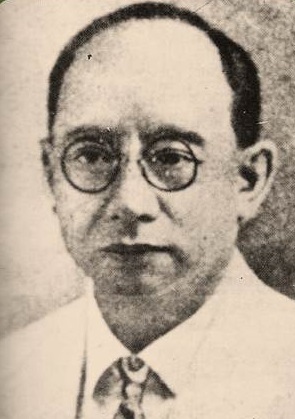
Tomás Mapúa y Bautista, architect of the St. La Salle Hall. © Prof. Xiao Chua

The cornerstone for the new school building was laid by the Archbishop of Manila, the Most Reverend Michael J. O'Doherty, in March of 1920. The St. La Salle Hall was completed almost four years after, owing to the phase-by-phase construction because of the Brothers' lack of funds. The new school building was officially opened in December 1924.

St. La Salle Hall in the 1930s. © Easyphil.com

According to an article by Arch. Augusto Villalon on the Philippine Daily Inquirer, the St. La Salle Hall is the only Philippine structure to be included in the coffee-table book 1001 Buildings You Must See Before You Die: The World's Architectural Masterpieces. Denna Jones, one of the book's contributors, Denna Jones, have written about the St. La Salle Hall as an epitome of classical and imperial style of architecture not just in the Philippines but also in Southeast Asia. 

"Mapúa's H-shaped, three-story reinforced concrete building is pure Classical expression. A triangular pediment crowns an entablature of cornice, frieze and architrave supported by Corinthian columns to create a three-bay portico main entrance."

"Wide, open-air portico wings extend from either side; the square openings on the third floor balanced over the rectangular openings of the upper floors? balustrade level. Corinthian pilasters and a dentiled cornice unite the floors between each arch."

"The interior quadrangle is similarly ordered but stripped to basic flat elements without benefit of pediment and entablature. A later addition of an exterior green metal slope-roof walkway wraps the ground level on the quadrangle side. The ground floor interior offsets Corinthian grandeur with the geometric simplicity of Tuscan columns, and a square coffered ceiling." (excerpt from Inquirer.net, original text by Denna Jones)

The Chapel of the Most Blessed Sacrament. © Manila Nostalgia/Isidra Reyes

In 1939, an addition was made to the St. La Salle Hall. Mapúa added a chapel on the western-most side of the building. After its completion, it was named as the Chapel of the Most Blessed Sacrament and was dedicated to St. Joseph.

The years 1941 to 1945 were bitter years for the Philippines. The country was unexpectedly and forcibly dragged into war as the Japanese landed on Philippine soil. The capital city, Manila, was bombed by enemy planes. So, La Salle, being located at the far end of the city and being far from the city center of Binondo, Ermita and Sta. Cruz, became a center of refuge for civilians.

De La Salle College, 1945. © Manila Nostalgia/Isidra Reyes

A shelled-out balcony of the St. La Salle Hall. © Prof. Xiao Chua

The Battle of Manila devastated and greatly reduced the Pearl of the Orient Seas into rubble. More than eighty (80) percent of the city's structures were either damaged or ruined. For the civilians, the date 12 February 1945 will forever be etched into their memories. It was when twenty-five (25) civilians and sixteen (16) Lasallian brothers were brutally massacred by the fanatical Japanese forces who vowed to fight to the death in the name of the Shōwa Emperor, known by many as Emperor Hirohito.


St. La Salle Hall shortly after the Battle of Manila in 1945. © De La Salle University

After the liberation of the City of Manila, the St. La Salle Hall was in shambles. Its exterior shelled by belligerent forces, and its halls filled with the stench of death coming from the dead bodies massacred by the Imperial Japanese Forces. Shortly after, the surviving Brothers began to put La Salle back on its feet, introducing more programs into its curriculum offerings. 

At present, the St. La Salle Hall is now returned into its former glory by demolishing the front structure which housed the Marilen Gaerlan Conservatory. Because of the demolition, the University would now have an additional green breathing space.


St. La Salle Hall at night. The Marilen Gaerlan Conservatory has not yet been demolished at this time. © iBlog La Salle

In its 103 years of existence as one of the premiere universities in the Philippines, the De La Salle University's St. La Salle Hall gives us stories to tell, stories that will forever be etched on its halls. The St. La Salle Hall is a witness to the country's colorful past, from the dark days of war to the liberation of an occupied nation, and will still be a witness to the progress of the nation in the future.


The St. La Salle Hall with the Marilen Gaerlan Conservatory demolished. © Aaron Sumayo

Monday, September 15, 2014

A.M. Shorts: First City National Bank Building


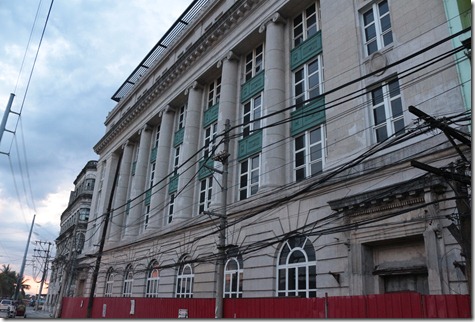
A faithful restoration being made at the First City National Bank Building, now known as the Juan Luna E-Services Building. © Interaksyon

Manila, capital of the Philippines for more than five hundred (500) years, is the seat of the country's political, educational, financial, and religious power. It's status as the country's primate city have earned the reputation of being the 'Most Beautiful City in the Far East' and as the 'Paris of Asia', but all these monikers were taken away after the city was greatly reduced into rubble during the dying days of the Second World War. Almost seventy years have past, and the city is still trying to regain its status as the finest city in the East. Here and there, new developments have been sprucing up, not to mention the priceless aspect called heritage. 

The city was once a lively city, with its streets lined with shops and department stores, theaters, banks, and social clubs. In one of these streets, a building called the First City National Bank stood, and still is, standing proudly along the banks of the Pasig River.

Construction of the First City National Bank in the early 1920s. © Manila Nostalgia/Isidra Reyes

The First City National Bank Building is a five-storey office building located along the corner of Calle Juan Luna, formerly Calle Anloague, and Muelle de la Industria in Binondo. One prominent building also stands along the thoroughfare which is the El Hogar Filipino Building. The building, a joint project between the International Banking Corporation and the Pacific Commercial Company, sits on a 1,800 square meter lot and is designed by the architectural firm Murphy, McGill, and Hamlin of New York in the beaux-arts style of architecture. Its design is said to be originated from the management of the International Banking Corporation, with its design coming from the trademark bank design of the company in other overseas branches. 

First City National Bank, viewed from the banks of the Pasig River. © Manila Nostalgia/Isidra Reyes

According to University of the Philippines' Prof. Gerard Lico's book entitled 'Arkitekturang Filipino: A History of Architecture and Urbanism in the Philippines', it is stated that the First City National Bank's design was a prototype of the other overseas bank branches.

"The bank’s prototype was made up of a row of colossal columns in antis, which was faithfully reproduced for its Manila headquarters. The ground floor was fully rusticated to effect a textured finish. This floor had arched openings with fanlights emphasized by stones forming the arch. The main doors were adorned with lintels resting on consoles. Above the ground floor were six three-storey high, engaged Ionic columns, ending in an entablature topped by a cornice. These six columns dominating the south and west facades were, in turn, flanked by a pair of pilasters on both fronts. The fifth floor was slightly indented and also topped by an entablature crowned by strip of anthemion." (excerpt from Arkitekturang Filipino: A History of Architecture and Urbanism in the Philippines)

The First City National Bank Building in the 1960s. 

The First City National Bank Building survived the horrors of the Battle of Manila in 1945. It was one of the few buildings left almost intact. During the post war years, the building was briefly used as the office of Ayala Life-FGU until they completely moved out to transfer to Makati. 

Recently, an interest on the First City National Bank Building was shown after it was bought by a business process outsourcing company to be converted into a call center. The building was renamed as the Juan Luna E-Services Building and is still under restoration. As of this year 2014, the restoration of the building is almost complete and will soon be ready to be leased to its new occupants.

The new Juan Luna E-Services Building currently under careful resotration. © Urban Roamer

Thursday, July 31, 2014

University of Santo Tomás Main Building

The University of Santo Tomás Main Building during the pre-war years. © Old Manila Nostalgia via Ram Roy

If there were to be a competition on the best university building anywhere in the Philippines, the best bet would be the University of Santo Tomás in Sampaloc, Manila. Many have bear witness to the building's colorful history. It has gone through the darkest days of war up to the present problems of the university -- flooding. The main building of Santo Tomás has a lot to offer to the community.

The Pontifical and Royal University of Santo Tomás, or UST, is a Catholic university run by the Order of Preachers, or simply known as the Dominicans. It is also the oldest university in Asia, being founded in 1611, even older than Harvard University itself. Many of the Philippines' distinguished men and women have either graduated or have attended at this prestigious university. Heroes like Dr. José P. Rizal, Marcelo H. del Pilar, and Emilio Jacinto; statesmen like Claro M. Recto, Manuel L. Quezón, and Sergio Osmeña have all attended Santo Tomás. 


Santo Tomás' new location in Sulucan Hills, now part of present-day Sampaloc. © Flickr/John Tewell

Before being located on its present site, Santo Tomás held its classes inside the walled city in Intramuros, where the old Santo Domingo Church also stood. The university had been wanting to move its operations outside Intramuros because of its ever-increasing student population. The move to a larger site was fulfilled only after three hundred years of being at its Intramuros campus. In 1911, a donation was given to the Dominican Fathers, a 22.1 hectare land located in Sulucan Hills, in the northeastern part of the city. The estate was then a property of the Sisters of Saint Clare, but in the early 1900s, they disposed off the land and sold to developers. One of the buyers, Doña Francisca Bustamante Bayot, donated the land to the Dominicans. The land was bordered by four streets: Calle España, Calle Gov. Forbes, Calle Dapitan, and Calle P. Noval. Because the new campus was more than enough to accomodate its population, the plan was that half of the property was originally intended for Colegio de San Juan de Letrán. However, the plan was not materialized.

Fr. Roque Ruaño, O.P., architect and engineer of the Main Building. © Wikipedia

The university received the donation of the Sulucan property in 1911, the tricentennial anniversary of Santo Tomás. In December of that year, the laying of the first cornerstone was made by the Dominican Fathers, headed by the university's Rector Magnificus Fr. José Noval, O.P., and other distinguished guests. 

The development of the new Sulucan property did not materialize until the 1920s due to lack of funds. However, the development of the design had already started. With the development of the new campus went into full swing, the project was handed over to Fr. Roque Ruaño, O.P., a Spanish Dominican who was a former rector of the Colegio de San Juan de Letrán. Ruaño, a civil engineer, had meticulously researched earthquake-proof engineering designs and had tested them when he designed Dominican friar houses in Baguio and Lingayen. 


Construction for the Main Building started in 1923. Rebars are being installed, as seen in the photo. © Manila Nostalgia/Prof. Vic Torres

Designed in the Renaissance Revival style of architecture, Fr. Ruaño's design for the Main Building was advanced in its time, as some say it still complies with today's National Building Code. Construction started in 1923, but Fr. Ruaño had already spent the last two years procuring building materials such as cement and rebars from Japan. 

"The Sulucan strata consisted of fine sand and loamy clay heavily interspersed with land and marine shells, a situation where the land layers moved at different directions during a tremor. This prompted Fr. Ruaño to combine two methods of laying foundations: Isolated piers were linked with a continuous slab foundation, so that the structures above would sway independently of each other during an earthquake. In five years, 200 workers from Pampanga slowly raised 40 separate small towers that provided the basic framework of what is today?s Main Building (it was called 'New Building' then, there being no other edifice in the campus). Fr. Ruaño kept revising his plans, the latest after a trip to Tokyo in 1926 where he observed the effects of the recent earthquake there and in Yokohama." (excerpt from Inquirer.net)


Construction of the Main Building taking place, circa 1923-1927. © Manila Nostalgia/Prof. Vic Torres


The Main Building has four floors, plus an additional nine-storey clock tower, which contained the water tanks for the hydraulic engineering laboratory. The building is seventy-four (74) meters wide and eighty-six (86) meters long, with two courtyards on each wing. The main engineering feat of the Main Building is that it was built in forty (40) separate structures so that the building would not easily crumble if an earthquake occurs. Also, an additional floor was added to accommodate laboratories.

The Main Building finally opened in time for the 1927-1928 school year. It was a relief for the university administration as they wanted to de-clog its Intramuros campus as fast as possible. After its opening in 1927, the Main Building, specifically the clock tower, served as the city's "Kilometer Zero" until it was replaced by the Rizal Monument in Luneta. 

Main Building, circa 1928. © Manila Nostalgia/Lou Gopal

After its opening, the university administration moved some of its operations at Sulucan. The colleges of Philosophy, Pharmacy, Education, Liberal Arts and Medicine held classes inside its halls. The university library also moved in Sulucan, occupying its northeast wing. 


Main Building during the 1930s. © Manila Nostalgia/Mon Ancheta

Because of the Main Building's grandeur, it was constructed right at the heart of the twenty-two hectare Sulucan property. It became the focal point of the university, in which the succeeding buildings were all built around it.

Pre-war Santo Tomás came into a halt in 1941 when the Japanese bombed the City of Manila. However, the Japanese occupation of the Philippine capital did not materialize until January of 1942 when the Philippine Commonwealth left Manila for Bataan. For Santo Tomás, war did not spare them from being dragged into occupation. The university was converted into an internment camp, being host to about four thousand Allied and foreign civilian prisoners-of-war, with nationalities such as American, British, Canadian, Australian, Dutch, Pole, Russian, Spanish, Cuban, Mexican, Burmese, Swedish, Danish, and Chinese.

After its establishment in 1942, the Santo Tomás Internment Camp became one of the largest in the Philippines.


Allied and other foreign internees made shantytowns in one of the Main Building's courtyards. © LIFE/Carl Mydans via Discovering the Old Philippines: People, Places, Heroes, Historical Events

An aerial view of the Main Building. Take note of the cramped shanties built in and around the Main Building. © Manila Nostalgia/Mon Ancheta

During the Japanese occupation of Santo Tomás, the university grounds literally became a miniature city. The Japanese had established a government inside, appointing an American named Lemuel Earl Carroll as its head. According to accounts, the internees owed so much to Carroll, stating that his leadership received favorable approval from the internees.


A Japanese propaganda photo depicting life inside Santo Tomás. © Santo Tomas Internment Camp/Lou Gopal

In February of 1945, the combined Filipino and American armies made an assault on the City of Manila. They first took Santo Tomás with the belief that the Japanese will execute all internees as they retreat from the capital. As the American tanks and troops advanced through the campus, they were met by Japanese resistance. The Japanese took the Education Building and held two hundred (200) internees hostage. After negotiations made by a British missionary named Ernest Stanley, the Japanese agreed to leave Santo Tomás and rejoined with other Japanese units in Manila.


The flag of the United States is draped at the canopy of the Main Building, signifying the liberation of the Santo Tomás Internment Camp from the Japanese. © LIFE/Carl Mydans via Wikipedia

The war had left most of the city into rubble. Santo Tomás, however, was not heavily damaged during the liberation as it was still host to a number of Allied war prisoners. After the war, life had returned to normal, students went back to school after a three and a half years hiatus. 


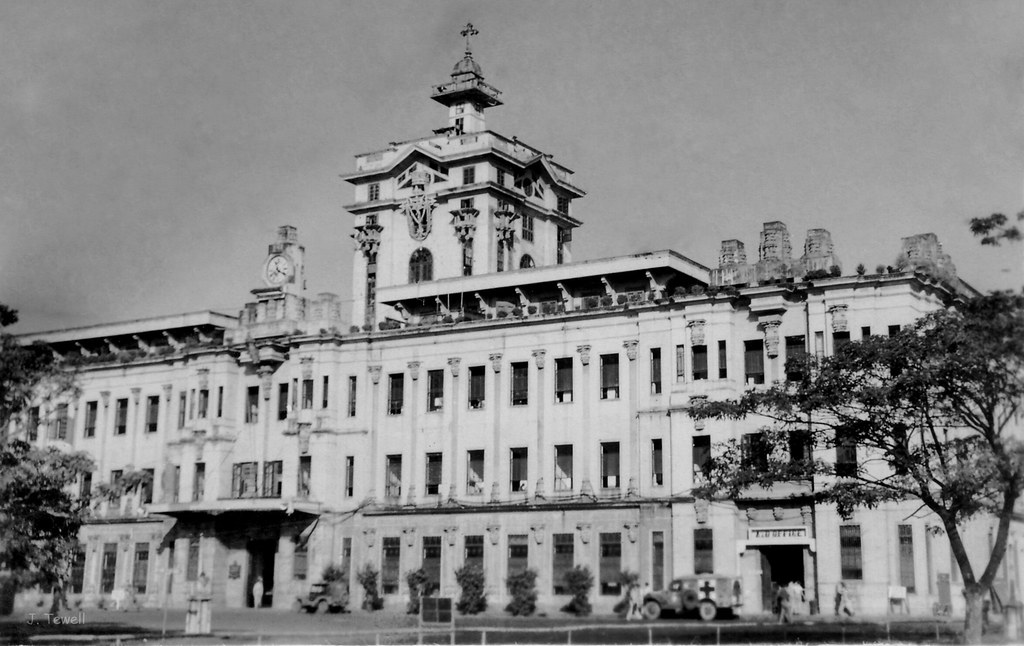
University of Santo Tomás Main Building circa 1945. © Flickr/John Tewell


In 1952, during the silver jubilee of the Main Building, an addition to the Main Building was made. Through the initiative of then-Rector Magnificus Fr. Ángel de Blas, O.P., fifteen (15) statues of famous saints, philosophers, and other personalities of the arts and sciences were installed at the pedestals made long before. In the original plan, Fr. Ruaño had purposely built pedestals to put in statues, but it was only made into fruition years after his death. The statues, measuring three meters in height, were sculpted by the great Francesco Riccardo Monti, an Italian expatriate and then-professor of the College of Fine Arts. Monti also made a number of significant works in Manila's buildings such as in the Manila Metropolitan Theater, Capitol Theater, Manila Electric Railroad and Light Company Building along Calle San Marcelino, and the Quezón Memorial.

THE INITIATOR AND THE SCULPTOR: The University's Rector Magnificus, Very Rev. Dr. Fr. Ángel de Blas, O.P. (left), and the master builder Francesco Riccardo Monti (right) © Anna Filippicci

In 2010, a year before the quadricentennial anniversary of the University, the National Museum of the Philippines declared the Main Building, along with other important structures in the University, as National Cultural Treasures.