Showing posts with label battle of manila. Show all posts

Tuesday, April 28, 2015

Crystal Arcade


The Crystal Arcade during its heyday. © Arquitectura Manila Photo File

The Philippine capital of Manila was a city of high stature, comparable to those fine cities of the Occident such as Paris, London, and Madrid. The pre-war years have given Manila to acclaim itself as the 'Most Beautiful City in the Far East' whilst Manila's neighbors, Hong Kong, Jakarta, Kuala Lumpur, and Singapore, were backwater outposts of their colonial masters. This is proven by the influx of European migrants and expatriates to the city in the first half of the 20th century. Germans, Spaniards, Americans, British, French, and Russians made Manila their home, at least, until the end of the Second World War. These migrants and expatriates mingled with the Philippine alta sociedad and had the city developed from a medieval Spanish city into a progressive capital of a semi-independent nation.


Shopping around the city is one of the best things to do in Manila. Long before the existence of modern Philippine shopping mall complexes such as Rustan's, Shoemart, Robinson's, and Ayala, the Crystal Arcade is considered the first shopping mall in the Philippines.

Façade of the Crystal Arcade. © Lougopal.com/Manila Nostalgia

The Crystal Arcade was one of the most modern buildings located along the Escolta, the country's then premier business district. Built on the land owned by the Pardo de Tavera family, an illustrious Filipino family of Spanish and Poruguese lineage, the modern building was designed by the great Andrés Luna de San Pedro, a scion of the latter. The Crystal Arcade was designed in the art deco style, a style prevalent in the 1920s to the 1940s. It was to be one of Luna's masterpieces, with the building finish resembled that of a gleaming crystal. 

The conception of a construction of the Crystal Arcade started in the 1920s as a pet project of Luna. Luna wanted to have the same prestige in the arts and architecture like that of his father, the great revolutionary-painter Juan Luna Novicio. To make such thing possible, he infused the sleek and streamline art deco design with crytal-like glass in his design for the building. 

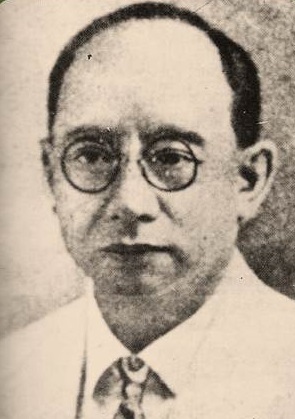
Andrés Luna de San Pedro (1887-1952) © Lougopal.com/Manila Nostalgia

The Crystal Arcade was inaugurated in June of 1932, and was the first shopping establishment, or the first commercial establishment that was fully air-conditioned. Its interiors reminded the Philippine elite of the arcades that of Paris, with covered walkways, glass covered display windows and cafés and other specialty shops.

Crystal Arcade interior, adorned with a pair of grand staircases. © Manila Nostalgia/Carmelo Mosqueda 

Inside the Crystal Arcade, one can find the home of the first Manila Stock Exchange, the precursor to today's Philippine Stock Exchange.

 A typical trading day at the Manila Stock Exchange inside the Crystal Arcade. 

According to sources, the Crystal Arcade was used to be owned by its architect, the great Andrés Luna de San Pedro, probably due to the land being owned by his maternal family, the Pardo de Taveras, but was foreclosed by its creditor, the El Hogar Filipino, due to the financial situation that came about during the Wall Street crash and the Great Depression in the late 1920s to the early 1930s. The Crystal Arcade was also planned to have more floors but was eventually scrapped because of lack of funds. 

When the Crystal Arcade opened in 1932, it was the most elegant building in the area as it was constructed with glass which illuminates like crystal at night. Its interiors were also as elegant as the exterior, showing art deco lines and motifs. 

"The Arcade had a mezzanine on both sides of a central gallery that ran through the length of the building and expanded at the center to form a spacious lobby containing curved stairways. Stairs, balconies, columns and skylight combined to create vertical and horizontal movement, as well as a play of light and shadow in the interior. Art deco bays pierced by a vertical window marked each end of the façade and complemented the tower over the central lobby. Wrought-iron grilles and stucco ornaments were in the art deco style featuring geometric forms, stylized foliage, and diagonal lines and motifs." (excerpt from Philippine Politics and Society in the Twentieth Century: Colonial legacies, post-colonial trajectories)

Escolta in 1937. The Crystal Arcade is on the left of the photo. © Lougopal.com/Manila Nostalgia

In 1941, the Second World War came to the Philippines only hours after Pearl Harbor was bombed. The capital city, Manila, was also bombed by the invading Japanese forces causing damage to the city. The following year, in January, triumphant Japanese forces entered the city despite of it being declared an open city. During the occupation years, the Crystal Arcade was home to Japanese occupation agencies such as the Japanese Government Railways and the Board of Tourist Industry. 

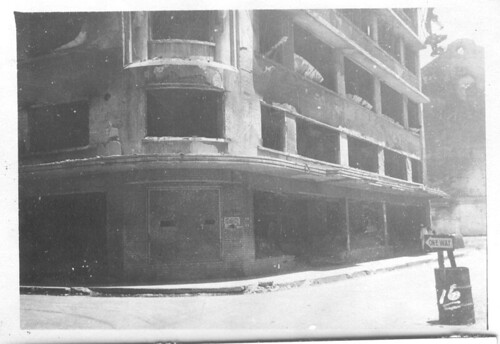
The year 1945, for those who lived in Japanese-occupied Manila, was probably the most traumatic and devastating year. In the months of February and March saw the most bitter fighting in all of the Pacific. Sixteen thousand (16,000) fanatical Imperial Japanese Navy soldiers fought American and Filipino forces to the last man, bringing with them about one hundred thousand (100,000) civilians massacred. The effect of this bitter fighting resulted in the near-total destruction of the City of Manila. More than eighty (80) percent of the city's structures were obliterated, many of them into extinction. The Crystal Arcade, located along the Escolta, was one of the casualties of war, Escolta being one of the areas of fierce combat.

A heavily damaged Crystal Arcade taken immediately after the liberation for Manila. © George Mountz Collection

Shelled-out interiors of the Crystal Arcade. © Lougopal.com/Manila Nostalgia

Immediately after the liberation of Manila, businesses soon opened even its locations were in shambles. In the Crystal Arcade, businesses reopened and some new businesses found a home in the Crystal Arcade. Only the first floor was occupied with stores and the second floor being a bodega, or storage room of the tenants. Eventually, in the 1960s, the Crystal Arcade was demolished to pave way for the post-war revival of the Escolta. Its successor, the new Philippine National Bank Building, designed by Carlos Argüelles, replaced the Crystal Arcade, the Lyric Theater, and the Brias Roxas Building.

Sunday, March 8, 2015

Heacock's Department Store


A typical scene outside Heacock's Department Store along the Escolta. © Manila Nostalgia/John Harper

Long before the existence of today's department stores such as Rustan's, Robinson's, and the ever-famous Shoemart, now known as SM, there were already department stores that were far more luxurious than that of today's. Manila, being the city that boasted numerous feats in architecture, also hosted and boasted the finest shops and stores in all of the Orient. One of these department stores was Heacock's, probably the most recognized and popular stores in the city back in the day.

Heacock's Department Store first became a jewelry store operating under the partnership name Heacock & Freer, two American brothers-in-law from San Francisco. H.E. Heacock, one of the partners, was a travelling salesman originally hailed from Salem, Ohio and first came to the Philippines in 1901 to open a branch of his jewelry store. After arriving in Manila, Heacock & Co. set up shop on the second floor of the McCullough Building at the foot of the Santa Cruz Bridge. Since then, Heacock & Co. became the best known American jewelry store in the city.

H.E. Heacock, one of the founders of H.E. Heacock & Company. © Filipinas Heritage Library

In 1909, the brothers-in-law Heacock and Freer sold the company to Samuel Francis Gaches, a young American entrepreneur-turned-philanthropist who arrived in Manila in the same year as Heacock, but the reason being is that Gaches worked for the American colonial civil service.

Samuel Francis Gaches, president of the H.E. Heacock & Company. © Filipinas Heritage Library

In the post-Gaches acquisition of the company, the year 1910, H.E. Heacock & Co. transferred its operations south, at an old building along the five-block Escolta. The old Escolta shop was renovated and had the most modern storefront in all of Manila with its products displayed in front, a first in the country. Eight years later, in 1918, Heacock's transferred its operations again due to the success of the department store. It moved one block east, along the Escolta corner Calle David. The new four-storey Heacock's Department Store was the most modern of its time. The department store was built on the lot of American businessman William J. Burke, the owner of the Burke Building on the Escolta.

The pre-1918 Heacock's Department Store along the Escolta. © Manila Nostalgia/Isidra Reyes

As the years progress, Heacock's grew larger in terms of popularity and in assets. The H.E. Heacock & Company opened branches in other parts of the Philippines such as in Baguio, Cebu, Davao, and Iloilo. Heacock's, being the country's largest department store back in the day, carried imported luxury goods from the Elgin Watch Company, which carried the brands Lord Elgin, Lady Elgin, and Elgin. Other brands include Remington Typewriters, Rogers Flatware, International Silver, and Frigidaire Refrigerators.

An ad from the Philippines Free Press dated December 1923 from Heacock's Department Store. © Manila Nostalgia/Aksyon Radio La Unión

The year 1929 saw the birth of a stronger and larger Heacock's Department Store. Gaches and the H.E. Heacock & Company started the construction of the one million peso (P1,000,000.00), eight-storey Federal style building on the corner of Calle Escolta and Calle David. The new Heacock Building was designed and constructed by the triumvirate of the Filipino architect Tomás Argüelles, the American W. James Odom, and the Spanish Insular Fernando de la Cantera. Opened a year later, the Heacock Building had the same features that of the old Insular Life Building at Plaza Moraga.

Construction of the new Heacock Building in 1929. © Lougopal.com/Manila Nostalgia 

In an article of the American Chamber of Commerce Journal in 1930, the new million-peso Heacock Building was described as being one of the tallest in the city. The article also described the interior layout of the department store.

"The main entrance on the Escolta opens into Heacock’s proper, the jewelry store; then comes Denniston’s, the photographic department, with its valuable Eastman agency, and then the office equipment department. The jewelry store is L-shaped; one of the illustrations gives a good view of it.

In the new building the Heacock store occupies the main and mezzanine floors, both handsomely finished and artistically arranged. The second floor is also all occupied by the Heacock company; the offices are there, and the stock, accounting, mail order, wholesale and optical departments. Four rooms on the third floor are given over to stock and records; the other rooms of that floor are rented as offices, as are the rooms and suites of the fourth, fifth and sixth floors. These rooms, all of them desirable because of their location and the building they are in, offer great latitude of choice.

The seventh floor accommodates Heacock’s engraving and printing, watch-making, metal engraving, jewelry repairing and manufacturing departments; also the optical shop, Denniston’s photo laboratories, and stock of the office equipment department.

The basement, under the entire building, counts as the eighth floor. It is to accommodate automobiles during the day. Seventy-five cars will not crowd it; a wide ramp opens from Calle David, egress and ingress are safe and convenient. This public service in connection with the Heacock building will materially mitigate the downtown parking nuisance." (excerpt from the American Chamber of Commerce Journal)

The new million-peso, eight-storey Heacock Building. © Manila Nostalgia/Isidra Reyes (Retrieved from Arquitectura Manila Photo File)

Interior of the Heacock Building on its opening in 1930. © Lougopal.com/Manila Nostalgia

The triumvirate-designed edifice only lasted for seven years. In 1937, a powerful earthquake hit the Philippine capital which heavily damaged the Heacock Building. The building suffered irreparable damages which led to the demolition of the eight-storey building. Heacock's shut down its business and was quickly reorganized a month after the earthquake. 

The new edifice, also eight stories high, replaced the old demolished Heacock Building. The new building, built in the streamline art deco style, was designed also by Tomás Argüelles, but with Fernando H. Ocampo and the American George E. Koster.

The new H.E. Heacock & Company Building in 1940. © Manila Nostalgia/Dominic Galicia

The streamline art deco building had the latest in building technology, it had installed pneumatic tubes which could transport small parcels throughout the building without the need of a messenger. The building cost around P800,000.00, which is P200,000.00 cheaper than the triumvirate-designed Federal style building. 

The new H.E. Heacock Building (center) houses Heacock's Department Store and the ammunition storage of the Philippine Army. © LIFE via Lougopal.com/Manila Nostalgia

The deadly Battle of Manila in 1945 greatly reduced the city into rubble. Escolta, home of the city's financial district, was obliterated by bombshells and gunfires. The Heacock Building was damaged but was reconstructed after the war. 

The war-torn H.E. Heacock Building, 1945. © Skyscrapercity.com


Friday, December 19, 2014

A.M. Shorts: Admiral Apartments

The Admiral Apartments back in the day, photo probably taken after the war. Ⓒ Manila Nostalgia/John Harper

The grandeur of pre-war Manila makes people of today reminisce about the past, the past that has been prosperous and plentiful. Manila, being the finest city in the Orient proves its stately grandeur through the representation of the city's finest homes, shops, and imposing structures. Sadly, many of the structures that Manila boasts and had boasted is now being turned into fine pieces of powder as they are being demolished to pave way for the so-called "progress".

Along the scenic Dewey Boulevard, where the pride of the City of Manila, the Manila Bay, is located, there were numerous stately homes and apartments that stood in front of its glowing waters. One of them is the Admiral, located at the corner of Dewey Boulevard and Cortabitarte. The Admiral Apartments had been home to numerous historical figures, both local and global, and had been a witness to the gruesome days of the Second World War.


Admiral Apartments during the post-war years. © Manila Nostalgia/Isidra Reyes

The Admiral Apartments along Dewey Boulevard, now Róxas Boulevard, was a work of the eminent Fernando H. Ocampo, whose other works include the Calvo Building along Escolta, Angela Apartments in Malate, and the post-war rehabilitation of the Manila Cathedral. Built in 1938 and completed in 1939, the Admiral Apartments was commissioned by Don Salvador Araneta Zaragoza and his spouse, Doña Victoria López de Araneta.


Salvador Araneta Zaragoza and Doña Victoria López de Araneta. 


The Admiral Apartments, after its opening in the late 1930s, was one of the tallest residential building in the city, with eight storeys high living quarters. Because of its height, the Admiral became the focal point of sailors and ships anchoring in Manila Bay. 

Modern-day Admiral Apartments-turned hotel. Ⓒ Manila Nostalgia/Isidra Reyes

According to Manila society legends, the Admiral was conceived by Doña Victoria's mother, Doña Ana López Ledesma. It was said that Doña Ana was responsible for financing the construction of the Admiral to please and impress the Aranetas, specifically Don Salvador's father Don Gregorio Araneta Soriano, because it has been told that Don Salvador had married Doña Victoria without their knowledge.

The Admiral was designed in the art-deco style, designed by the eminent Fernando H. Ocampo. According to an architectural historian, he described the Admiral of having "an air of quiet elegance with definite Spanish touches in the design of its façade. The apartments were pleasant spacious, airy, and bright rooms. The Spanish feeling became more pronounced in the reception room that opened directly to a side street. Both the furniture and the metal chandeliers reflected a Spanish Gothic style, rather forbidding in its formality." (excerpts from a PowerPoint presentation by Isidra Reyes. Retrieved from Manila Nostalgia)

The features of the Admiral's interiors, such as the main dining halls, were designed with different themes and motifs. "The main dining room, called the Malayan Court, was so-called due to the strong Malayan motif of its design and an imposing mural painting by Antonio Dumlao. The Spanish Room was a reception room while a small dining room called the Blue Room was done in royal blue, old rose, crystal, and silver. A cocktail lounge called the Coconut Grove was decorated with a coconut trees with green light bulbs as fruits, inspired by the Cocoanut Grove Nightclub at the Ambassador Hotel in Los Angeles." (excerpts from a PowerPoint presentation by Isidra Reyes. Retrieved from Manila Nostalgia)

During the war, the couple's own home, the Victoneta I, was seized by the Japanese and made it their headquarters. So, the couple and their family moved to the Admiral to seek refuge, along with other members of the López-Araneta families. It has been said that Doña Victoria personally did the washing of the dirty linens and taking phone calls as the Admiral Apartments was understaffed. In the last days of the war, the Japanese took control of the Admiral Apartments. With that, the Araneta couple moved out of the Admiral and sought refuge in Baguio along with other members of the López-Araneta family. 


The Admiral Apartments (top center), during the liberation of Manila in 1945.Ⓒ Manila Nostalgia/Andi Desideri 

The battle for the liberation of the City of Manila left most of the city in ruins. The Admiral Apartments was not severely damaged in the fight for the recapture of the Philippine capital. Shortly before the capitulation of the Japanese forces in the Philippines, top commanders of Allied nations in the Pacific stayed in the Admiral Apartments. The Supreme Commander of the Allied Forces in the Pacific and Field Marshal of the Philippine Army Douglas MacArthur has made the Admiral his temporary home after his home in nearby Manila Hotel was bombed out during the liberation. The British supreme commander, The Earl Mountbatten of Burma, formerly Prince Louis of Battenberg, uncle of Prince Philip, Duke of Edinburgh, also stayed in the Admiral Apartments.

Construction workers demolish the Admiral Apartments. Ⓒ GMA News/Danny Pata

This year, in 2014, news regarding the Admiral Apartments sparked when it was reported that it is being demolished to pave way for a new development, the Admiral Hotel by Anchor Land Holdings. Petitions have been made throughout social media by heritage conservation activists and ordinary citizens alike, saying that the capital city of Manila has already had too much "massacre" of heritage buildings. The petition for the stopping of the demolition had reached the Manila City Hall, but took a blind eye on the issue. So, the developer, Anchor Land Holdings, continued the demolition, much to the disappointment and frustrations of heritage conservationists.

The year 2014 has already been a roller-coaster ride for Philippine heritage. No concrete plans and actions have been laid out by the government for the protection of heritage structures. As long as there are no concrete and stricter laws regarding the destruction of heritage structures, they will fall prey to greedy developers whose aim is to destroy the country's physical heritage. 

Thursday, November 6, 2014

De La Salle University St. La Salle Hall


The St. La Salle Hall of the De La Salle University during its heyday. © Manila Nostalgia/Gilbert Jose

Many have either walked past by this building or have walked through its halls. This outstanding structure is the epitome of institutional architecture in the Philippines, mainly because of its classical ornaments such as its white-washed walls and spacious halls. The St. La Salle Hall embodies the spirit of not just of the green and white, but also embodies the triumph of Catholic education in the Philippines.

Lasallian education in the Philippines was established in 1910 when the pioneer brothers arrived. It was not until in 1911 when the Brothers opened a school, which was then called the De La Salle College, at the Pérez Samanillo compound in Calle Nozaleda in Paco. Ten years later, as the student population began to increase and due to the lack of space, the De La Salle College moved to a much wider lot in the southwestern part of the city, along Taft Avenue in Malate.


Construction of the St. La Salle Hall of then-De La Salle College. © Manila Nostalgia/Gaby Tinio


A competition for the design of the new school building was initiated by the Lasallian brothers. Tomás Mapúa, a pensionado architect, won the competition against nine other entries and was awarded with a prize of P5,000.00. Mapúa is the country's first registered architect who was one of the first-generation pensionado architects who studied abroad. Educated in Cornell University in New York, he became one of the country's leading architects during the pre-war years, with projects such as the De La Salle University's St. La Salle Hall and the Philippine General Hospital. 

Tomás Mapúa y Bautista, architect of the St. La Salle Hall. © Prof. Xiao Chua

The cornerstone for the new school building was laid by the Archbishop of Manila, the Most Reverend Michael J. O'Doherty, in March of 1920. The St. La Salle Hall was completed almost four years after, owing to the phase-by-phase construction because of the Brothers' lack of funds. The new school building was officially opened in December 1924.

St. La Salle Hall in the 1930s. © Easyphil.com

According to an article by Arch. Augusto Villalon on the Philippine Daily Inquirer, the St. La Salle Hall is the only Philippine structure to be included in the coffee-table book 1001 Buildings You Must See Before You Die: The World's Architectural Masterpieces. Denna Jones, one of the book's contributors, Denna Jones, have written about the St. La Salle Hall as an epitome of classical and imperial style of architecture not just in the Philippines but also in Southeast Asia. 

"Mapúa's H-shaped, three-story reinforced concrete building is pure Classical expression. A triangular pediment crowns an entablature of cornice, frieze and architrave supported by Corinthian columns to create a three-bay portico main entrance."

"Wide, open-air portico wings extend from either side; the square openings on the third floor balanced over the rectangular openings of the upper floors? balustrade level. Corinthian pilasters and a dentiled cornice unite the floors between each arch."

"The interior quadrangle is similarly ordered but stripped to basic flat elements without benefit of pediment and entablature. A later addition of an exterior green metal slope-roof walkway wraps the ground level on the quadrangle side. The ground floor interior offsets Corinthian grandeur with the geometric simplicity of Tuscan columns, and a square coffered ceiling." (excerpt from Inquirer.net, original text by Denna Jones)

The Chapel of the Most Blessed Sacrament. © Manila Nostalgia/Isidra Reyes

In 1939, an addition was made to the St. La Salle Hall. Mapúa added a chapel on the western-most side of the building. After its completion, it was named as the Chapel of the Most Blessed Sacrament and was dedicated to St. Joseph.

The years 1941 to 1945 were bitter years for the Philippines. The country was unexpectedly and forcibly dragged into war as the Japanese landed on Philippine soil. The capital city, Manila, was bombed by enemy planes. So, La Salle, being located at the far end of the city and being far from the city center of Binondo, Ermita and Sta. Cruz, became a center of refuge for civilians.

De La Salle College, 1945. © Manila Nostalgia/Isidra Reyes

A shelled-out balcony of the St. La Salle Hall. © Prof. Xiao Chua

The Battle of Manila devastated and greatly reduced the Pearl of the Orient Seas into rubble. More than eighty (80) percent of the city's structures were either damaged or ruined. For the civilians, the date 12 February 1945 will forever be etched into their memories. It was when twenty-five (25) civilians and sixteen (16) Lasallian brothers were brutally massacred by the fanatical Japanese forces who vowed to fight to the death in the name of the Shōwa Emperor, known by many as Emperor Hirohito.


St. La Salle Hall shortly after the Battle of Manila in 1945. © De La Salle University

After the liberation of the City of Manila, the St. La Salle Hall was in shambles. Its exterior shelled by belligerent forces, and its halls filled with the stench of death coming from the dead bodies massacred by the Imperial Japanese Forces. Shortly after, the surviving Brothers began to put La Salle back on its feet, introducing more programs into its curriculum offerings. 

At present, the St. La Salle Hall is now returned into its former glory by demolishing the front structure which housed the Marilen Gaerlan Conservatory. Because of the demolition, the University would now have an additional green breathing space.


St. La Salle Hall at night. The Marilen Gaerlan Conservatory has not yet been demolished at this time. © iBlog La Salle

In its 103 years of existence as one of the premiere universities in the Philippines, the De La Salle University's St. La Salle Hall gives us stories to tell, stories that will forever be etched on its halls. The St. La Salle Hall is a witness to the country's colorful past, from the dark days of war to the liberation of an occupied nation, and will still be a witness to the progress of the nation in the future.


The St. La Salle Hall with the Marilen Gaerlan Conservatory demolished. © Aaron Sumayo

Sunday, May 12, 2013

Manila City Hall

The Manila City Hall at night. © Panoramio/jsantiago

Civic and government edifices built during the American occupation would always stand out, as it reminds us of the importance of these institutions. The Manila City Hall is one of the key government buildings constructed in American Manila. 

The Manila City Hall during the Japanese occupation, circa 1942. Photo taken from the walled city of Intramuros. © Flickr/Beyond Forgetting

The Manila City Hall during its construction stage, taken from the Legislative Building along P. Burgos Drive. © Manila Nostalgia/Ingrid Donahue via Lou Gopal

The Manila City Hall was designed by architect Antonio Toledo and was built in 1939. The city hall is adorned by a hexagonal tower with three clocks on three of its facets. After its completion, the building received negative reviews for its lack of aesthetics, lack of entrances and how the clock tower was placed.

The elevation plan for the Manila City Hall's iconic clocktower© Arkitekturang Filipino

The City Hall's courtyard during the Japanese occupation, circa 1942. © LIFE via Arkitekturang Filipino

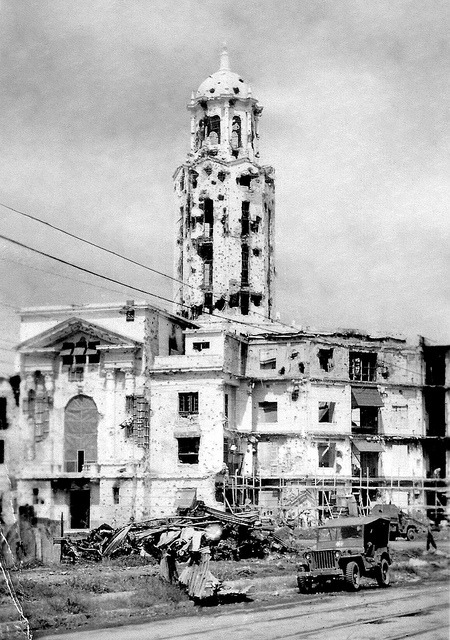
Sadly, the City Hall was not spared from the ravages of war. During the Battle of Manila, the city hall was heavily damaged from shelling. 

The shelled city hall viewed from Burgos Drive. © Skyscrapercity.com

The city hall after the Battle of Manila in 1945. © Flickr/ Beyond Forgetting


Manila City Hall's tower bombed out by artillery shells during the dying days of the war in the capital. © Tumblr/MLQ3 

After the war, the city hall was rebuilt through the War Reparations program of the United States and was criticized due to the shape of its floor plan which looked like a coffin or a shield of the Knights Templar. According to urban legends, it was made to look like a coffin to pay homage to those who died during the Battle of Manila.

The city hall's clocktower as viewed from the courtyard. © L' Heure Bleue

The courtyard. © Senor Enrique

One of the city hall's balconies facing the National Museum and Taft Avenue. © The Hippie Mum

Manila's iconic clock tower in the present time. © Wikimedia Commons

Sunday, May 5, 2013

San Agustín Church, Museum and Monastery

San Agustín before the powerful 1880 earthquake. © Life (Photo retrieved from Goldwin + Vina)

Women go crazy when they hear this church, saying that it is their dream wedding church. Because of its elegant interiors, this is the place of choice for weddings. For many, this is truly the most beautiful church, not just in Manila, but in the entire Philippines as well. Dubbed as the 'Wedding Capital of the Philippines, the San Agustín is the oldest stone church in the country.

The location of the San Agustín inside the walled city.

Concealed inside the 64-hectare walled city of Manila is the San Agustín Church. The church was a monument to the Spanish conquest of the Philippines. It was the first church to be built by the Spaniards in Luzon after relocating the capital from Cebu.

The church courtyard is adorned by several granite sculptures of Chinese lions, given by Chinese converts to Catholicism. The layout of the church is in the form of a Latin cross. It has fourteen side chapels and a trompe l'oeil ceiling painted in 1875 by Italian artists Cesare Alberoni and Giovanni Dibella. Up in the choir loft are hand-carved 17th-century seats of molave, a tropical hardwood.

The church contains the tomb of Spanish conquistadors Miguel López de Legazpi, Juan de Salcedo and Martín de Goiti, as well as several early Spanish Governors-General and archbishops. Their bones are buried in a communal vault near the main altar.

Tombs of some of the well-known scions in Philippine society. © Simbahan.net

Tombs of Spanish-Filipino industrialists Don Jacobo Zóbel Zangróniz and Don Antonio de Ayala. © Flickr/Jun Acullador

 The mortal remains of the Adelantado Don Miguel López de Legazpi interred in San Agustín. © Flickr/The Traveler Who Likes To Stay At Home 

The present San Agustín is the third structure erected on the same site. The first was made of bamboo and nipa, and was completed in 1571. It was destroyed by fire in 1574 during an attempted invasion of Chinese pirate Limahong. The second structure was made of wood and was again destroyed by fire in 1583. The fire started when a candle touched the drapes during the funeral of then Governor-General Gonzalo Ronquillo de Peñalosa. In 1586, construction of the final structure started based on the designs of Spanish architect Juan Macías. The third and final structure was made of adobe stone which was quarried from nearby towns of Binangonan, San Mateo and Meycauayan. 

The San Agustín still bearing its other belfry, circa late 1700s. © Arkitekturang Filipino

San Agustín became operational in 1604 and was declared complete in 1607 and was named Iglesia San Pablo de Manila. In 1762, the British forces invaded Manila during the Seven Years War, which involved Spain and Great Britain. During the British occupation of Manila, San Agustín's valuables were looted.

The interior of San Agustín's nave viewed from the choir loft. © Augustinian Churches and History

In 1854, Spanish architect Luciano Oliver was commissioned to renovate San Agustín. Then in 1875, two Italian painters Cesare Alberoni and Giovanni Dibella were commissioned to paint the ceiling of San Agustin. The two painters used the trompe l'oeil style where in a painting would look like a 3D figure.

  San Agustín's ornate and Renaissance-like trompe l'oeil ceilings. The ceilings were painted by Italians Dibella and Alberoni. © Flickr/Juan Paulo

"Sedate and direct to the point, the facade follows the style of High Renaissance. The symmetrical composition is prefixed by pairs of Tuscan columns that flank the main door of the two-tiered facade. The vertical movement of the paired columns is adapted at the second level by equally paired Corinthian columns. At the second level, mass and void alternate in a simple rhythm of solid walls and windows. The two levels, emphasized by horizontal cornices, are then capped by a pediment that is accentuated with a simple rose window.

Some of the trompe l'oeil details found inside San Agustín. © Simbahan.net

The facade’s hard composition is held together by two towers; unfortunately, the missing left belfry further exaggerates the lackluster facade. It was taken down after a destructive earthquake hit the church in 1863 and 1880, splitting the tower in two.

The trompe l'oeil dome at the transept crossing looks like the Renaissance churches in Europe. © Simbahan.net

The facade has a touch of Baroque by the ornately carved wooden doors that depict floras and religious images. Baroque is also evident in the carved niches that quietly reside between the paired lower columns. The church is bequeathed with Chinese elements in the form of fu dogs that emphatically guard the courtyard entrances." (excerpt from the Heritage Conservation Society)

Large glass chandeliers adorned the church's interior. The chandeliers were installed in the 19th century and were imported from France. © A Muse Astray

San Agustín measures 67.15 meters long and 24.93 meters wide. Its elliptical foundation has allowed it to withstand the numerous earthquakes that have destroyed many other Manila churches. It is said that the design was derived from churches built by the Augustinians in Mexico. The façade is unassuming and even criticized as "lacking grace and charm", but it has notable baroque touches, especially the ornate carvings on its wooden doors. 

Inside the nave, glass chandeliers adorned the church's interior. According to Fr. Pedro Galende, O.S.A., curator of the San Agustín Museum, the chandeliers were purchased and imported from France during the 19th century. The chandeliers survived the 1863, 1880 earthquakes and recently survived the Battle of Manila in World War II. 

In 1863, a devastating earthquake hit Manila which led to the destruction of most buildings. Only San Agustín was left undamaged. Then in 1880, a series of powerful earthquakes struck Manila. But this time, the earthquake left San Agustín with a huge crack on its left belfry. The belfry was eventually repaired, but soon after, it was permanently removed as it appears at the present time.

San Agustín after the devastating 1880 earthquake which left a huge crack on the left belfry. © Arkitekturang Filipino

In 1898, San Agustín became the place of surrender of the Spanish troops after the mock battle of Manila Bay during the Spanish-American War.

San Agustín with its left belfry removed. © Intramuros Manila

47 years later, San Agustín became a target of artillery pieces. During the final days of the Battle of Manila, the Japanese retreated inside Intramuros and used it as a defense barrier because of its thick and high walls. Long before the war, Intramuros was considered a 'holy city' because of the number of religious institutions situated in the 64-hectare city. San Agustín became a hospital and an internment camp.


The pews in the nave of San Agustín are in a mess. The church became a hospital and later an internment camp. © Flickr/dennis_raymondm19

After the liberation, all of Manila was reduced in rubbles. Important districts of the city were gone such as Sta. Cruz, Binondo, Ermita, and Tondo. Intramuros was the most devastated district with almost all buildings wiped out. Only San Agustín was left standing.


American GIs pause for a prayer in front of San Agustín during the Battle of Manila. © LIFE (photo retrieved from Tropicalpenpals.com)

San Agustín after the liberation. San Agustín was the only structure in Intramuros left standing. © Flickr/John Tewell

In 1993, San Agustín along with other four churches was designated by UNESCO as a World Heritage Site for its contribution to Philippine history. 


San Agustín as it looks in the present time. © Philippine Weddings