Showing posts with label beaux-arts. Show all posts

Monday, September 15, 2014

A.M. Shorts: First City National Bank Building


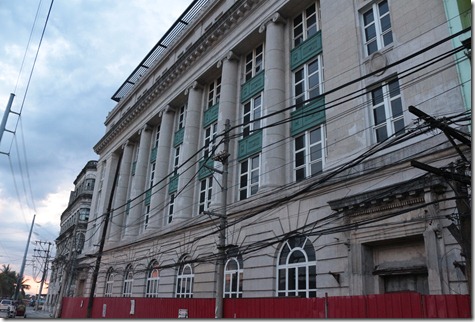
A faithful restoration being made at the First City National Bank Building, now known as the Juan Luna E-Services Building. © Interaksyon

Manila, capital of the Philippines for more than five hundred (500) years, is the seat of the country's political, educational, financial, and religious power. It's status as the country's primate city have earned the reputation of being the 'Most Beautiful City in the Far East' and as the 'Paris of Asia', but all these monikers were taken away after the city was greatly reduced into rubble during the dying days of the Second World War. Almost seventy years have past, and the city is still trying to regain its status as the finest city in the East. Here and there, new developments have been sprucing up, not to mention the priceless aspect called heritage. 

The city was once a lively city, with its streets lined with shops and department stores, theaters, banks, and social clubs. In one of these streets, a building called the First City National Bank stood, and still is, standing proudly along the banks of the Pasig River.

Construction of the First City National Bank in the early 1920s. © Manila Nostalgia/Isidra Reyes

The First City National Bank Building is a five-storey office building located along the corner of Calle Juan Luna, formerly Calle Anloague, and Muelle de la Industria in Binondo. One prominent building also stands along the thoroughfare which is the El Hogar Filipino Building. The building, a joint project between the International Banking Corporation and the Pacific Commercial Company, sits on a 1,800 square meter lot and is designed by the architectural firm Murphy, McGill, and Hamlin of New York in the beaux-arts style of architecture. Its design is said to be originated from the management of the International Banking Corporation, with its design coming from the trademark bank design of the company in other overseas branches. 

First City National Bank, viewed from the banks of the Pasig River. © Manila Nostalgia/Isidra Reyes

According to University of the Philippines' Prof. Gerard Lico's book entitled 'Arkitekturang Filipino: A History of Architecture and Urbanism in the Philippines', it is stated that the First City National Bank's design was a prototype of the other overseas bank branches.

"The bank’s prototype was made up of a row of colossal columns in antis, which was faithfully reproduced for its Manila headquarters. The ground floor was fully rusticated to effect a textured finish. This floor had arched openings with fanlights emphasized by stones forming the arch. The main doors were adorned with lintels resting on consoles. Above the ground floor were six three-storey high, engaged Ionic columns, ending in an entablature topped by a cornice. These six columns dominating the south and west facades were, in turn, flanked by a pair of pilasters on both fronts. The fifth floor was slightly indented and also topped by an entablature crowned by strip of anthemion." (excerpt from Arkitekturang Filipino: A History of Architecture and Urbanism in the Philippines)

The First City National Bank Building in the 1960s. 

The First City National Bank Building survived the horrors of the Battle of Manila in 1945. It was one of the few buildings left almost intact. During the post war years, the building was briefly used as the office of Ayala Life-FGU until they completely moved out to transfer to Makati. 

Recently, an interest on the First City National Bank Building was shown after it was bought by a business process outsourcing company to be converted into a call center. The building was renamed as the Juan Luna E-Services Building and is still under restoration. As of this year 2014, the restoration of the building is almost complete and will soon be ready to be leased to its new occupants.

The new Juan Luna E-Services Building currently under careful resotration. © Urban Roamer

Sunday, April 6, 2014

El Hogar Filipino Building


The El Hogar Filipino, one of the city's oldest American era structures, now on the verge of destruction. © Historic Preservation Journal

'Every building has its own story'. Yes, everything, from people to buildings, each has its own story to tell. Structures, though they are non-humans, have also experienced what humans had experienced, such as wars, revolutions, calamities, etc. Buildings, especially old ones, are reminders of a particular era that they were in. So, they are meant to be preserved as they are our physical gateway to the past. The City of Manila boasts many structures that tell stories, many of which have seen the capital transform from an ever loyal Spanish city, to a vibrant American Pearl of the Orient Seas, and to a colorful yet chaotic capital of the Philippine Republic.   

The El Hogar Filipino Building is one of those structures that tell stories of the past. The building has seen numerous events, from the American insular government to the Philippine Commonwealth, from the Second Philippine Republic to the liberation of the city, and finally the independence of the country in 1946.

An old colored photo, probably a postcard, of the El Hogar Filipino Building. © Manila Nostalgia/Isidra Reyes

The El Hogar, known in Spanish as the Edificio El Hogar Filipino, is a five-storey office building designed in the beaux-arts/renaissance/neo-classical styles of architecture. Located along Calle Muelle dela Industria by the Pasig River, the El Hogar is flanked by the First City National Building on the right, and the Hong Kong and Shanghai Bank Building on its rear and was designed by Spanish-Filipino engineer Don Ramón José de Irureta-Goyena Rodríguez. The El Hogar was built sometime between 1911 and 1914, which it was said to be a wedding present in celebration of the marriage of Doña Margarita Zóbel y de Ayala, sister of patriarch Don Enrique Zóbel y de Ayala, and Don Antonio Melián Pavía, a Spanish businessman who was titled as the Conde de Peracamps

Don Ramón José de Irureta-Goyena Rodríguez, architect of the El Hogar Filipino. © Manila Nostalgia/Paquito dela Cruz

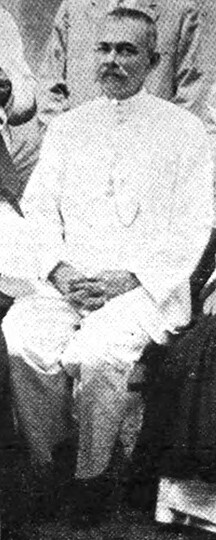
Don Antonio Melián Pavía, el Conde de Peracamps, and owner of the El Hogar Filipino. © Manila Nostalgia/Paquito dela Cruz

The El Hogar Filipino was owned by Spanish businessman and Conde de Peracamps, Don Antonio Melián Pavía. According to the Cornejo's Commonwealth DirectoryMelián was born in the Canary Islands in Spain on May 21, 1879. From Spain, he sailed to Peru in 1903 where he held posts in the insurance company La Previsora and in the Casino Español de Lima. In 1907, he married Don Enrique's sister Doña Margarita Zóbel y de Ayala. In 1910, he sailed from Peru back to the Philippines and established the El Hogar Filipino and the Filipinas Compañía de Seguros together with his brothers-in-law Enrique and Fernando Zóbel y de Ayala. 


Note: Names are written in standard Spanish naming custom. Spanish names are written without the Filipino 'y'. So, for males (or single females), it would be [given name][paternal family name][maternal family name]. For married females, it would be [given name][paternal family name][maternal family name]de[husband's family name]. For widows, it would be [given name][paternal family name][maternal family name]vda.de[husband's family name]

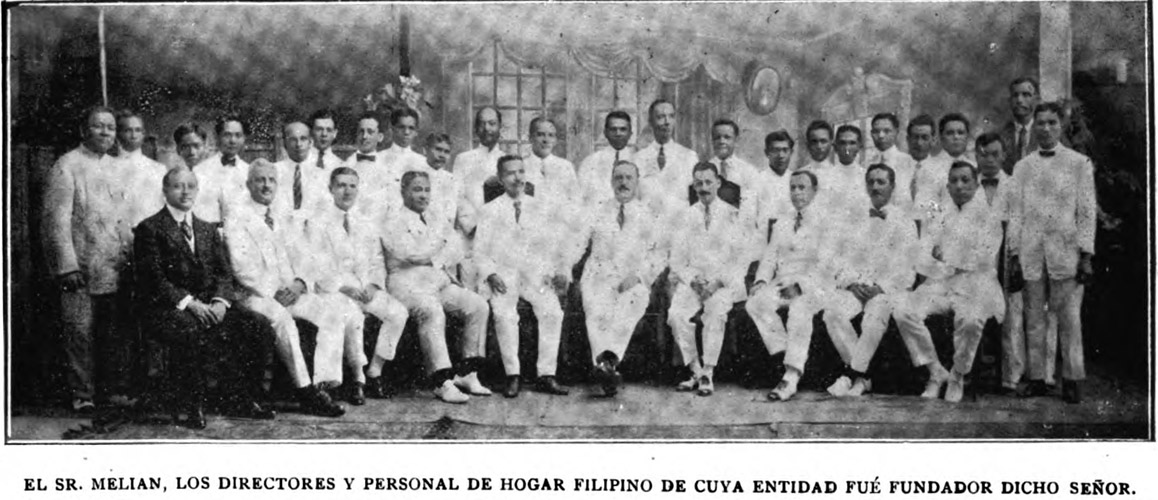
A group photo of the El Hogar Filipino leaders and employees. The Conde de Peracamps is seated at the center, with Don Francisco Ortigas Barcinas (seated, sixth from right), Don Enrique Zóbel y de Ayala (seated, fourth from right), and his brother Don Fernando Zóbel y de Ayala (seated, third from right). The description reads: Sr. Melián, with the directors and employees of El Hogar Filipino whose company was founded by the said gentleman. © Manila Nostalgia/Paquito dela Cruz

The El Hogar (left), and the First City National Bank Building (right) viewed from the other side of the Pasig River. © Manila Nostalgia/Ingrid Donahue via Lou Gopal

The El Hogar housed the Melián business empire, such as the Filipinas Compañía de Seguros, Tondo de Beneficiencia, Casa de España, Casa de Pensiones, and El Hogar Filipino. Other tenants of the El Hogar include Ayala y Compañía, Sociedad Lizárraga Hermanos, and Smith, Bell and Company. The Filipinas Compañía de Seguros moved out of the El Hogar in the 1920s after the completion of its own building at the foot of the Jones Bridge in Plaza Moraga, a short walk from the El Hogar. 


The El Hogar during the 1920s. © Philippine History and Architecture 

One of the building's interesting features is that the building has its own garden courtyards, not one, but two. Another feature that make the El Hogar unique was its mirador, or balcony. From the El Hogar's balcony, one can see the Pasig River, the southern part of Manila, which includes the walled city of Intramuros, Ermita, and Malate. Also, the El Hogar's staircase is considered as one of the most ornate in the city, with a sculpted mythical griffin, as its base. 

The El Hogar's intricate staircase grillwork, which included a sculpture of a mythical griffin. © Manila Nostalgia/Isidra Reyes

A memorial plaque in which encases the El Hogar's time capsule. The plaque reads: Excmo. Sr. Don Antonio Melián y Pavía, Conde de Peracamps. Funadador de 'El Hogar Filipino' 1911. It has been reported that the plaque has been removed, and so as the time capsule. © Manila Nostalgia/Stephen John Pamorada 

The El Hogar survived the Battle of Manila in 1945 and only suffered minor damages. In the post-war years, the lending company El Hogar Filipino had closed down, along with other Melián businesses, leaving only the Filipinas Compañía de Seguros. Because of this, the Meliáns sold the El Hogar to the Fernandez family, and the El Hogar was rented out to other companies. The building was finally abandoned as an office building some decades ago. Since the Muelle dela Industria area had a chaotic, Brooklynesque vibe, it became the set for films and television shows. 

El Hogar and the First City National Bank Buildings in the late 1960s. © Definitely Filipino

Just this year, news involving the El Hogar sparked when it was reported that it was sold to a Chinese-Filipino real estate developers, which reported that it will demolish the El Hogar because of the building's stability, and be turned into a condominium. The news spread like a wildfire throughout heritage conservationists, cultural advocates, and ordinary citizens alike. Heritage conservationists had written to both the city government of Manila and the National Historical Commission of the Philippines, or NHCP, to stop the demolition of the El Hogar. Because of this, a petition to stop the demolition was created. As of today, 730 supporters have already signed the petition. The new owner of the El Hogar however, who was not named, said that they do not have plans of demolishing the El Hogar, but will use it as a warehouse instead. 

Details of the El Hogar. One can see the beaux-arts elements such as arched windows present in the building. © Historic Preservation Journal


The El Hogar's mirador gives it a unique charm, and one can view the Pasig River and other areas of the city. © Historic Preservation Journal

It is our responsibility as citizens to preserve and take care of the built heritage our forefathers left. They may seem not significant to many, but they also have witnessed numerous triumphs and challenges the country experienced. They may be inanimate objects, but they also have its own character and its own story to tell. If these buildings could talk, we believe that they are pleading to us citizens right now to help save them. 

At Arquitectura Manila, we educate Filipinos of our glorious architectural past through this website. As heritage conservation advocates, we believe that all heritage structures, not just the El Hogar, be given justice as it we are only its caretakers. If the El Hogar was to be restored, it should be turned into something productive, just like its neighbor First City National Bank, maybe something like a boutique hotel, or New York-style apartments with cafés and restaurants on its lobby. And, who knows, the El Hogar may be host to the country's first standalone luxury boutique?

Wednesday, June 26, 2013

Jones Bridge


The Jones Bridge during its prime years. © Flickr/John T. Pilot

Have you ever wondered why Manila was called names such as "Queen of the Pacific", "Pearl of the Orient", "Venice and Paris of the Orient", "Paris on the Prairie", and "Most Beautiful City in the Far East"? It is because of its architectural beauty, a melting pot of cultures from Europe, America and Asia thus create a fusion of east and west. Bridges were part of Manila's architectural beauty, one of the was the ever-beautiful Jones Bridge. Jones is not just a bridge, it's the bridge for it is considered as "Manila's Queen of all Bridges".

Jones Bridge's most famous photo, alongside with other Arellano masterpieces such as the Post Office Building and the Manila Metropolitan Theatre© Arkitekturang Filipino

The Jones Bridge was a neo-classical (but more of a beaux-arts) bridge designed by the great Juan Arellano, who also built a number of prominent structures in Manila, namely the Post Office Building, the Old Legislative Building (now the National Museum), and the Metropolitan Theatre. The bridge spans the Pasig River which connects Burgos Drive at one end, and at Plaza Cervantes on the other. 


The Jones Bridge during the 1920s. Note that the construction of the Post Office Building has just started. © Arkitekturang Filipino

The Jones Bridge replaced a much smaller bridge a few meters from the present site. The old Puente de España was built in 1875 during the Spanish occupation of the Philippines. During the American occupation, the bridge was widened so it could accommodate more traffic. Then in 1914, non-stop rains damaged the bridge's piers. In 1916, the Americans commissioned Juan Arellano, who was then a member of the Bureau of Public Works, to design a bridge.

Jones Bridge during its construction. © Arkitekturang Filipino

Workers installing the steel frames of the Jones Bridge. © Arkitekturang Filipino

The construction of the new bridge started in 1919 and was completed in 1920. The bridge was inaugurated in 1921 as Jones Bridge, in honor of the American lawmaker William Atkinson Jones.

The Jones Bridge is reminiscent to those of Paris, particularly the Pont Alexandre III. © Skyscrapercity.com

An illustration of the gilded piers, balustrades, lampposts, and arches of the grand Jones Bridge. © Arkitekturang Filipino

Aside from its ornate piers, arches, and balustrades, there were four (4) pillars with statues adorned the bridge. The famous of all the statues was the La Madre Filipina, or "The Filipina Mother". All the statues were commissioned by Juan Arellano to sculptor Martinez.

La Madre Filipina. © Nostalgia Filipinas

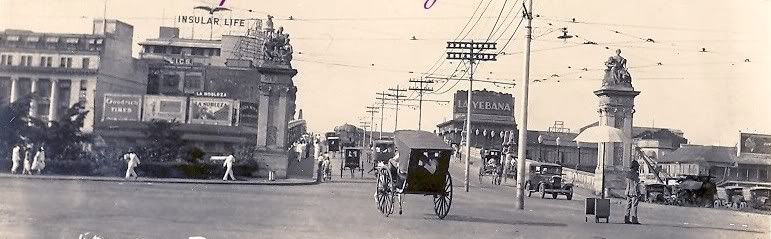
Jones Bridge facing north, going towards Binondo. Note the two pillars adorning the bridge. © Skyscrapercity.com

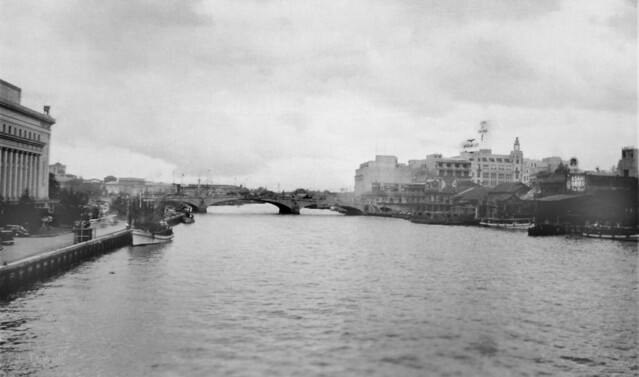
Jones Bridge looking west towards Manila Bay. The Post Office can be seen on the left side and the Binondo and Escolta business area on the right. © Flickr/John T. Pilot

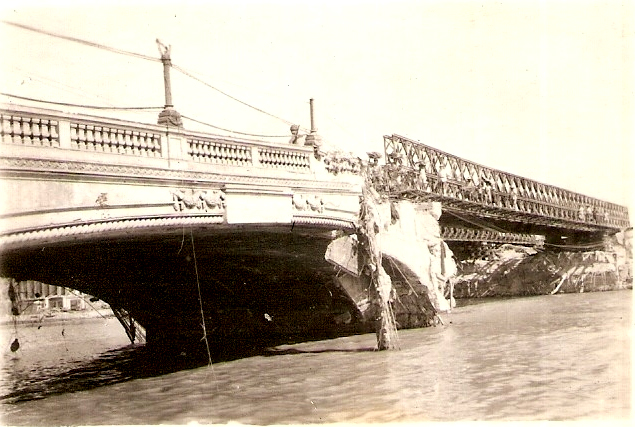
The Battle of Manila brought destruction to the entire city, including the Jones Bridge. The bridge was bombed by the Japanese Imperial Forces in to delay the advance of the American forces. After the war, it was rebuilt through the Philippine Rehabilitation Act. The bridge was rebuilt still under its original name, but not its original neo-classical design.

Jones Bridge after the war. A temporary bailey bridge was installed to connect the two points of the city. © Lougopal.com


After the war, the bridges four pillars were placed throughout the city. The most famous, the La Madre Filipina, was placed at the Rizal Park. The two other pillars were reportedly seen at the Court of Appeals Building in Manila, and the other one is nowhere to be found.

Jones Bridge at the present time. ©Flickr/risadlp