Showing posts with label juan arellano. Show all posts

Saturday, May 3, 2014

A.M. Shorts: Salvador Araneta and Victoria López Residence


'Victoneta I', the Salvador Araneta and Victoria López residence in Mandaluyong. Ⓒ Manila Nostalgia/Derrick Manas

Manila's pre-war homes were some of the most beautiful in the Far East, for the city was host to landed families of Spanish, Chinese, and American descents. These stately homes got an upper hand location-wise, in which some of the houses were built either in the Spanish enclave of San Miguel or at the new American area of Ermita. But this is not always the case. Some families actually chose to build their homes outside of the city, where one can feel the cool breeze of the wind. An example of this was in Mandaluyong, a town not far from Manila, where the 'Victoneta' was built.

The 'Victoneta I', owned by the aristocratic couple Salvador Araneta and Victoria López de Araneta, was one of the stately homes built outside the city. Built in 1933 by three architects, namely Domingo Lerma, and the greats Juan Arellano and Andrés Luna de San Pedro, the Victoneta won the title 'Most Beautiful Home of 1933' because of Doña Victoria's luxurious taste. The house boasts a number of feats: the Victoneta had thirty-three rooms, making it one of the largest houses in the city, it had a private chapel with its own entrance, and was designed by three architects in different phases because of its massive size.

Doña Victoria López and Don Salvador Araneta. Ⓒ Manila Nostalgia/Isidra Reyes 

Don Salvador Araneta Zaragoza is the son of Don Gregorio Araneta Soriano. Both are members of the illustrious Spanish-Filipino Araneta family, whose roots hail from Gipuzkoa in the Basque Country of Spain. Doña Victoria López was a member of the López sugar barons of Iloilo, where her first cousin Don Eugenio López Hofileña was one of the country's richest men during the post-war years.

Note: Names are written in standard Spanish naming custom. Spanish names are written without the Filipino 'y'. So, for males (or single females), it would be [given name][paternal family name][maternal family name]. For married females, it would be [given name][paternal family name][maternal family name]de[husband's family name]. For widows, it would be [given name][paternal family name][maternal family name]vda.de[husband's family name].

One of Victoneta's many patios and gardens. © Manila Nostalgia/Isidra Reyes

Victoneta's chapel entrance. Ⓒ Manila Nostalgia/Isidra Reyes

As stated earlier, the Victoneta was built in 1933 by architects Domingo Lerma, Juan Arellano and Andrés Luna de San Pedro using the Hispano-Moresque-Mediterranean styles of architecture. Because of its grandeur, it won the title 'Most Beautiful Home of 1933'. Located on a 17,000 square meter property in Mandaluyong, Victoneta was a portmanteau of the names Victoria and Araneta, the names of the house owners. One of Victoneta's features was the chapel. The chapel had intricate seats whose interiors were designed by the great Andrés Luna de San Pedro. 

Chapel interiors of the Victoneta designed by Andrés Luna de San Pedro. Ⓒ Manila Nostalgia/Isidra Reyes 


An overview of the grand sala© Manila Nostalgia/Isidra Reyes

The Victoneta had a lot of rooms because of Doña Victoria López de Araneta's tastes. The house had a very large sala, or living room, where the Aranetas had the great Fernando Amorsolo commission a painting for them entitled 'The First Baptism in the Philippines'. Unfortunately, the painting, along with the rest of the house, were destroyed during the liberation of Manila in 1945. 

One of the bedrooms at VictonetaⒸ Manila Nostalgia/Isidra Reyes

Victoneta's grand sala. A massive painting commissioned to Fernando Amorsolo hangs on its walls. Ⓒ Manila Nostalgia/Isidra Reyes

The war years were a time of hardship for the Araneta couple. It has been said that the Japanese had been eyeing the house because of its sprawling property. The Aranetas vacated the house after it was confiscated by the Japanese, and left Manila for Baguio to be with the other Araneta and López family members. In 1945, the Victoneta was used as a refugee center where around seventy civilians were interred. As the combined Filipino and American forces were closing in to Manila, the Japanese had a bomb planted inside the chapel. Unfortunately, the bomb went off after a Filipino refugee accidentally detonated it. All of the refugees inside were instantly killed.  

Victoneta's dining area. © Manila Nostalgia/Isidra Reyes

 Victoneta's chapel lay in ruins after the liberation of Manila in 1945. Ⓒ Isidra Reyes/Edwina Litton Ortigas

After the war, Don Salvador and Doña Victoria had decided not to rebuild the Victoneta, due to the reason that many lives were killed inside. Instead, the Araneta couple abandoned the property and relocated to Malabon, where another house also named Victoneta stood. 


The original Victoneta just laid in ruins for decades after 1945. The ruins were finally demolished recently.

Wednesday, June 26, 2013

Jones Bridge


The Jones Bridge during its prime years. © Flickr/John T. Pilot

Have you ever wondered why Manila was called names such as "Queen of the Pacific", "Pearl of the Orient", "Venice and Paris of the Orient", "Paris on the Prairie", and "Most Beautiful City in the Far East"? It is because of its architectural beauty, a melting pot of cultures from Europe, America and Asia thus create a fusion of east and west. Bridges were part of Manila's architectural beauty, one of the was the ever-beautiful Jones Bridge. Jones is not just a bridge, it's the bridge for it is considered as "Manila's Queen of all Bridges".

Jones Bridge's most famous photo, alongside with other Arellano masterpieces such as the Post Office Building and the Manila Metropolitan Theatre© Arkitekturang Filipino

The Jones Bridge was a neo-classical (but more of a beaux-arts) bridge designed by the great Juan Arellano, who also built a number of prominent structures in Manila, namely the Post Office Building, the Old Legislative Building (now the National Museum), and the Metropolitan Theatre. The bridge spans the Pasig River which connects Burgos Drive at one end, and at Plaza Cervantes on the other. 


The Jones Bridge during the 1920s. Note that the construction of the Post Office Building has just started. © Arkitekturang Filipino

The Jones Bridge replaced a much smaller bridge a few meters from the present site. The old Puente de España was built in 1875 during the Spanish occupation of the Philippines. During the American occupation, the bridge was widened so it could accommodate more traffic. Then in 1914, non-stop rains damaged the bridge's piers. In 1916, the Americans commissioned Juan Arellano, who was then a member of the Bureau of Public Works, to design a bridge.

Jones Bridge during its construction. © Arkitekturang Filipino

Workers installing the steel frames of the Jones Bridge. © Arkitekturang Filipino

The construction of the new bridge started in 1919 and was completed in 1920. The bridge was inaugurated in 1921 as Jones Bridge, in honor of the American lawmaker William Atkinson Jones.

The Jones Bridge is reminiscent to those of Paris, particularly the Pont Alexandre III. © Skyscrapercity.com

An illustration of the gilded piers, balustrades, lampposts, and arches of the grand Jones Bridge. © Arkitekturang Filipino

Aside from its ornate piers, arches, and balustrades, there were four (4) pillars with statues adorned the bridge. The famous of all the statues was the La Madre Filipina, or "The Filipina Mother". All the statues were commissioned by Juan Arellano to sculptor Martinez.

La Madre Filipina. © Nostalgia Filipinas

Jones Bridge facing north, going towards Binondo. Note the two pillars adorning the bridge. © Skyscrapercity.com

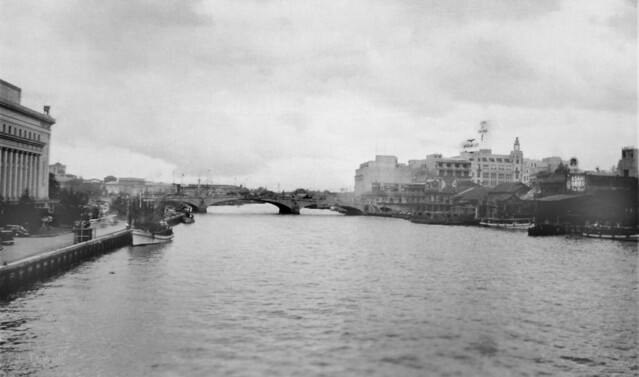
Jones Bridge looking west towards Manila Bay. The Post Office can be seen on the left side and the Binondo and Escolta business area on the right. © Flickr/John T. Pilot

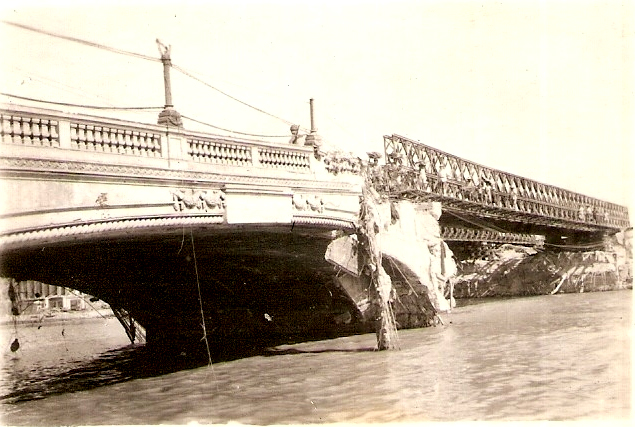
The Battle of Manila brought destruction to the entire city, including the Jones Bridge. The bridge was bombed by the Japanese Imperial Forces in to delay the advance of the American forces. After the war, it was rebuilt through the Philippine Rehabilitation Act. The bridge was rebuilt still under its original name, but not its original neo-classical design.

Jones Bridge after the war. A temporary bailey bridge was installed to connect the two points of the city. © Lougopal.com


After the war, the bridges four pillars were placed throughout the city. The most famous, the La Madre Filipina, was placed at the Rizal Park. The two other pillars were reportedly seen at the Court of Appeals Building in Manila, and the other one is nowhere to be found.

Jones Bridge at the present time. ©Flickr/risadlp

Friday, April 12, 2013

Old Legislative Building (National Museum of the Philippines)


The old Legislative Building during the pre-war years. © Skyscrapercity.com

The old Legislative Building is, without a doubt, the best example of neo-classical architecture in the Philippines. It has been the place for the country's statesmen for decades, it has witnessed wars, demonstrations and calamities.

The Legislative Building during its construction in the 1920s. © Arkitekturang Filipino

The building today is the present National Museum of the Philippines. Located on Burgos Drive, this imposing edifice stands across the old walled city of Manila (Intramuros). Originally designed by the American Ralph Harrington Doane and Filipino Antonio Toledo in 1918 to be the future National Library as intended for the Burnham Plan of Manila.

An aerial view of the walled city of Intramuros. In the foreground is the Legislative Building. © Flickr/John Tewell


The building's front and side portion colonnaded with beautiful Corinthian columns. © Pinoy Shooter

The construction of the building started in 1918, but had delays because of funding. In 1926, the Philippine Legislature decided to move into the building and thus changing the layout of its interiors. The interiors of the structure was designed by the great Juan Arellano, who also built several Manila edifices such as the Post Office Building and the Manila Metropolitan Theatre.

A plan for the City of Manila done by the American urban planner Daniel Burnham. The positioning of the government edifices is seen near the old walled city. © Wikipedia 

The Legislative Building was completed in 1926 and was inaugurated on July 11 of the same year. Both the Philippine Legislature and the National Library occupied the building. The total cost of construction was $2,000,000.00 or P4,000,000.00 in 1926 value.

The Session Hall of the Senate, circa 1926. © Official Gazette


"The Old Session Hall of the Senate of the Philippines is a chamber like no other in the country. Soaring three stories to the top of the Old Legislative Building, the hall was clearly intended to be nothing less than a secular cathedral – a temple of wisdom for enlightened debate and the making of laws.

During the early 1920s in the American colonial period, when the architect Juan Arellano was revising the plans of Ralph Harrington Doane in order to convert the building from the museum and library it was originally designed to be the seat of the legislature, the Senate was led by Manuel L. Quezon, the leader of the movement for Philippine independence from the United States. It is highly probable that Senate President Quezon exercised much influence over the design of the chamber where he would preside over the body that he himself had helped establish in 1916. With his strong personal aesthetic, well-known taste for grandeur, and deep belief in the need to promote confidence and respect by the Americans in the nascent all-Filipino institutions, it is easy to picture Quezon working with Arellano on the dimensions and decoration of the Session Hall. Whatever the case, the result was breathtaking with the combination of the lofty space with its mezzanine galleries for the public and the dizzying range of precast ornamentation crowned by a magnificent hardwood ceiling."

The Legislative Building viewed from Burgos Drive. © Corregidor.org

"The most impressive features of the hall, taking full advantage of the architectural space, are undoubtedly the series of Corinthian columns and pilasters, the main wall above the rostrum with its fretwork and garlands, and most of all, the sculptural groupings surrounding the top of the hall. This ornamentation and all other decoration in the Hall was the work of the most celebrated Filipino sculptor of the time, Isabelo Tampinco—a contemporary of Juan Luna and Jose Rizal—and his sons Angel and Vidal. Tampinco gave full rein to his deep knowledge of classical sculpture, as well as to his personal artistic mission of Filipinizing many of the traditionally Western elements and motifs of the neoclassical style. The result, an entablature of great lawmakers and moralists through history and allegorical groupings, was and remains to this day an outstanding and unique achievement in Philippine art.

 Filipino masses gather outside the Legislative Building for the inauguration of the Philippine Commonwealth and its first president, Manuel L. Quezon. © Flickr/Sepia Lens

The standing figures of the entablature represent great lawmakers and moralists of history ranging from antiquity and Biblical times to the twentieth century, and include Kalantiaw and Apolinario Mabini on the East (Main) Wall; Pope Leo XIII and Woodrow Wilson on the West (Rear Wall); Moses, Hammurabi, Rameses the Great, Li Si, Augustus and William Blackstone on the North (Right) Wall; and Solon, Averroes, Justinian, Manu, Charlemagne and Hugo Grotius on the South (Left) Wall. Surrounding the cartouches on all four walls are allegorical groupings representing sovereignty, progress, arts and culture, industry, trade, farming, education, and so on." (excerpt from Official Gazette)

An aerial view of the inauguration of President Manuel L. Quezon outside the Legislative Building. © The Kahimyang Project

Manuel L. Quezon's oath as President of the Commonwealth of the Philippines. Notice the ornate podium of the Legislative Building. © Flickr/Manuel Quezon III

In 1935, the Legislative Building became the place of inauguration of the newly-established Philippine Commonwealth. Also, this is where the late President Manuel L. Quezon was inaugurated. 

The Legislative Building before the establishment of the Philippine Commonwealth. © Skyscrapercity.com via Nostalgia Filipinas

According to the description, it is a massive rectangular building which has a central portion flanked by two interior courts. The central portion houses both the Lower and Upper Houses. On the main floor, the House of Representatives held its sessions there while the Senate is on the third floor. The senate chamber has a fifteen (15) meter high ceiling. On its walls are statues of Filipino heroes and legislators, and on the two wings of the building are the offices of the legislators.

The ever-beautiful central facade of the Legislative Building adorned with Corinthian columns, ornate carvings and statues. © Facebook/Paulo Alcazaren via Nostalgia Filipinas

A two-storey, four-columned portico adorned the entrance of the Legislative Building. Over it is a triangular pediment with sculptures representing Luzon, Visayas, Mindanao, Law, Education, Commerce, and Agriculture. On each end of the building is a two-columned portico complimenting its central facade. The sculptures were designed and made by Otto Fischer-Credo, a German expatriate who resided in the Philippines during the pre-war years. He was recalled back to Germany during the war years to be an artist for the Third Reich, and did sculptures for Adolf Hitler and SS chief Heinrich Himmler.

The front pediment of the Legislative Building containing sculptures representing Luzon, Visayas, Mindanao (center), Law and Education (left), Agriculture and Commerce (right). © Arkitekturang Filipino

The Japanese occupation of the Philippines meant a halt to the existing Commonwealth Government. The Japanese had set up a Japanese-Sponsored Government headed by the late Pres. Jose P. Laurel. The building was used as the assembly hall of the puppet government. The speaker of the National Assembly was Benigno Aquino, Sr., grandfather of Pres. Benigno 'BS' Aquino III.


 A motorcade for Japanese Prime Minister Hideki Tojo in front of the old Legislative Building on May 5, 1943. © Manila Nostalgia/Rene Dominguez 

The Legislative Building became the home of the Japanese-Sponsored Republic of the Philippines. It became a home to Japanese propaganda. © Arkitekturang Filipino

A colored photo of the Senate chamber during the Japanese occupation. On the podium speaking is Sec. Jorge Vargas. Take note of the Japanese military officer seated. © Presidential Museum and Library

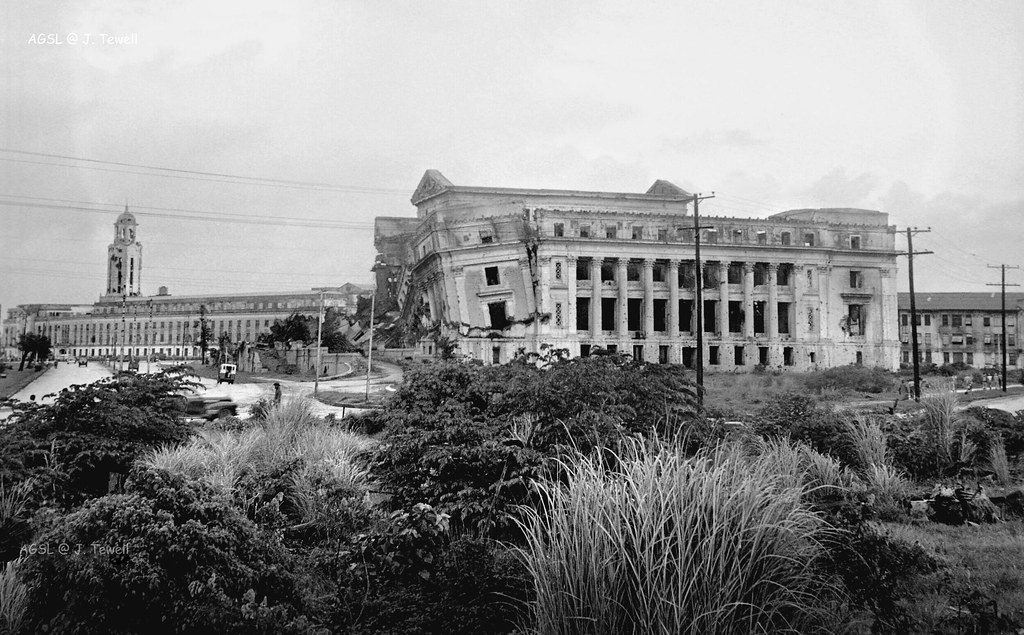
In February of 1945, American troops entered Manila trying to liberate the city from the Japanese Imperial Army. The battle became the worst urban fighting in the Pacific, sweeping eighty (80) percent of Manila's buildings. The Legislative Building was not spared from total annihilation. Because of its massive size and thick walls, it became the headquarters of the Japanese Imperial Army. The Americans shelled the building until it was totally destroyed. Only the central portion of the building stood but still had major damages. 

A 2000lb bomb being dropped by American bombers onto the City of Manila. © WWII in Color via Nostalgia Filipinas

A colored photo of the destroyed Legislative Building. © Presidential Museum and Library

The war-torn Legislative Building. Note that the left portion of the building was still standing. © Flickr/John Tewell

The Legislative Building (center), together with the Manila City Hall (left) and the Philippine Normal School (right), in ruins after a heavy battle for the city. © Flickr/John Tewell

Manila became an urban battlefield in which 100,000 civilians were killed. Many of Manila's imposing structures were destroyed such as the Post Office, the Agriculture and Finance Buildings, the UP campus, etc. After the Philippines became an independent nation in 1946, the United States aided the Philippines with some $400,000,000.00 of war damage payments, another $120,000,000.00 for public works and left a total of $100,000,000.00 worth of war surplus.

Reconstruction of the Legislative Building is underway. © Skyscrapercity.com 

The reconstruction of the Legislative Building started in 1949 until 1950. The building was renamed from "Legislative Building" to "Congress-Republic of the Philippines". The post-war version of the building was not as accurate as the pre-war version. The original plans were not followed, the once colonnaded facade having the full, engaged columns were replaced with a less ornate pilasters. 

The post-war Legislative Building. The building was rebuilt using the same dimensions, but with lesser ornamentations. © Skyscrapercity.com

After its reconstruction, Congress once again held its sessions until 1972, when Proclamation 1081 (Martial Law) was implemented by President Ferdinand Marcos. The building was re-inscribed with the name "Executive House" which was lent to different government agencies such as the Office of the Prime Minister on the fourth floor, the Office of the Ombudsman (Tanodbayan) on the third floor, the National Museum on the second floor and the Sandiganbayan (Peoples' Advocate) on the first floor. 

Leaders of SEATO member nations gather outside the Legislative Building in Manila during a summit in 1966. Notice the less ornate portico of the post-war structure. © Flickr/Manhhai

The Senate, House of Representatives and other various government agencies occupied the Legislative Building until 1997 when the Senate relocated its offices at the GSIS Building in Pasay, making the National Museum its only occupant. The "National Museum act of 1998" was turned into law which makes the Legislative Building, together with its adjacent buildings, the former Agriculture and Finance Buildings under their care. 

In 2010, the Legislative Building was declared a National Historical Landmark by the National Historical Commission of the Philippines. Also on the same year, the National Museum began the restoration of the Session Hall, returning its pre-war grandeur. The hall's restoration was completed in October, 2012.

The newly-restored Senate Session Hall of the Legislative Building. Restoration of the Session Hall was completed in 2012. © Interaksyon.com