A typical scene outside Heacock's Department Store along the Escolta. © Manila Nostalgia/John Harper
Long before the existence of today's department stores such as Rustan's, Robinson's, and the ever-famous Shoemart, now known as SM, there were already department stores that were far more luxurious than that of today's. Manila, being the city that boasted numerous feats in architecture, also hosted and boasted the finest shops and stores in all of the Orient. One of these department stores was Heacock's, probably the most recognized and popular stores in the city back in the day.
Heacock's Department Store first became a jewelry store operating under the partnership name Heacock & Freer, two American brothers-in-law from San Francisco. H.E. Heacock, one of the partners, was a travelling salesman originally hailed from Salem, Ohio and first came to the Philippines in 1901 to open a branch of his jewelry store. After arriving in Manila, Heacock & Co. set up shop on the second floor of the McCullough Building at the foot of the Santa Cruz Bridge. Since then, Heacock & Co. became the best known American jewelry store in the city.

H.E. Heacock, one of the founders of H.E. Heacock & Company. © Filipinas Heritage Library
In 1909, the brothers-in-law Heacock and Freer sold the company to Samuel Francis Gaches, a young American entrepreneur-turned-philanthropist who arrived in Manila in the same year as Heacock, but the reason being is that Gaches worked for the American colonial civil service.

Samuel Francis Gaches, president of the H.E. Heacock & Company. © Filipinas Heritage Library
In the post-Gaches acquisition of the company, the year 1910, H.E. Heacock & Co. transferred its operations south, at an old building along the five-block Escolta. The old Escolta shop was renovated and had the most modern storefront in all of Manila with its products displayed in front, a first in the country. Eight years later, in 1918, Heacock's transferred its operations again due to the success of the department store. It moved one block east, along the Escolta corner Calle David. The new four-storey Heacock's Department Store was the most modern of its time. The department store was built on the lot of American businessman William J. Burke, the owner of the Burke Building on the Escolta.

The pre-1918 Heacock's Department Store along the Escolta. © Manila Nostalgia/Isidra Reyes
As the years progress, Heacock's grew larger in terms of popularity and in assets. The H.E. Heacock & Company opened branches in other parts of the Philippines such as in Baguio, Cebu, Davao, and Iloilo. Heacock's, being the country's largest department store back in the day, carried imported luxury goods from the Elgin Watch Company, which carried the brands Lord Elgin, Lady Elgin, and Elgin. Other brands include Remington Typewriters, Rogers Flatware, International Silver, and Frigidaire Refrigerators.

An ad from the Philippines Free Press dated December 1923 from Heacock's Department Store. © Manila Nostalgia/Aksyon Radio La Unión
The year 1929 saw the birth of a stronger and larger Heacock's Department Store. Gaches and the H.E. Heacock & Company started the construction of the one million peso (P1,000,000.00), eight-storey Federal style building on the corner of Calle Escolta and Calle David. The new Heacock Building was designed and constructed by the triumvirate of the Filipino architect Tomás Argüelles, the American W. James Odom, and the Spanish Insular Fernando de la Cantera. Opened a year later, the Heacock Building had the same features that of the old Insular Life Building at Plaza Moraga.

Construction of the new Heacock Building in 1929. © Lougopal.com/Manila Nostalgia
In an article of the American Chamber of Commerce Journal in 1930, the new million-peso Heacock Building was described as being one of the tallest in the city. The article also described the interior layout of the department store.
"The main entrance on the Escolta opens into Heacock’s proper, the jewelry store; then comes Denniston’s, the photographic department, with its valuable Eastman agency, and then the office equipment department. The jewelry store is L-shaped; one of the illustrations gives a good view of it.
In the new building the Heacock store occupies the main and mezzanine floors, both handsomely finished and artistically arranged. The second floor is also all occupied by the Heacock company; the offices are there, and the stock, accounting, mail order, wholesale and optical departments. Four rooms on the third floor are given over to stock and records; the other rooms of that floor are rented as offices, as are the rooms and suites of the fourth, fifth and sixth floors. These rooms, all of them desirable because of their location and the building they are in, offer great latitude of choice.
The seventh floor accommodates Heacock’s engraving and printing, watch-making, metal engraving, jewelry repairing and manufacturing departments; also the optical shop, Denniston’s photo laboratories, and stock of the office equipment department.
The basement, under the entire building, counts as the eighth floor. It is to accommodate automobiles during the day. Seventy-five cars will not crowd it; a wide ramp opens from Calle David, egress and ingress are safe and convenient. This public service in connection with the Heacock building will materially mitigate the downtown parking nuisance." (excerpt from the American Chamber of Commerce Journal)

The new million-peso, eight-storey Heacock Building. © Manila Nostalgia/Isidra Reyes (Retrieved from Arquitectura Manila Photo File)

Interior of the Heacock Building on its opening in 1930. © Lougopal.com/Manila Nostalgia
The triumvirate-designed edifice only lasted for seven years. In 1937, a powerful earthquake hit the Philippine capital which heavily damaged the Heacock Building. The building suffered irreparable damages which led to the demolition of the eight-storey building. Heacock's shut down its business and was quickly reorganized a month after the earthquake.
The new edifice, also eight stories high, replaced the old demolished Heacock Building. The new building, built in the streamline art deco style, was designed also by Tomás Argüelles, but with Fernando H. Ocampo and the American George E. Koster.

The new H.E. Heacock & Company Building in 1940. © Manila Nostalgia/Dominic Galicia
The streamline art deco building had the latest in building technology, it had installed pneumatic tubes which could transport small parcels throughout the building without the need of a messenger. The building cost around P800,000.00, which is P200,000.00 cheaper than the triumvirate-designed Federal style building.

The new H.E. Heacock Building (center) houses Heacock's Department Store and the ammunition storage of the Philippine Army. © LIFE via Lougopal.com/Manila Nostalgia
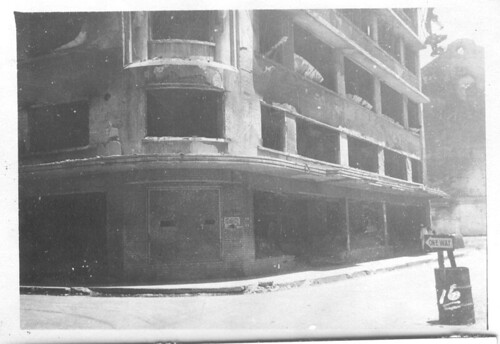
The deadly Battle of Manila in 1945 greatly reduced the city into rubble. Escolta, home of the city's financial district, was obliterated by bombshells and gunfires. The Heacock Building was damaged but was reconstructed after the war.

The war-torn H.E. Heacock Building, 1945. © Skyscrapercity.com